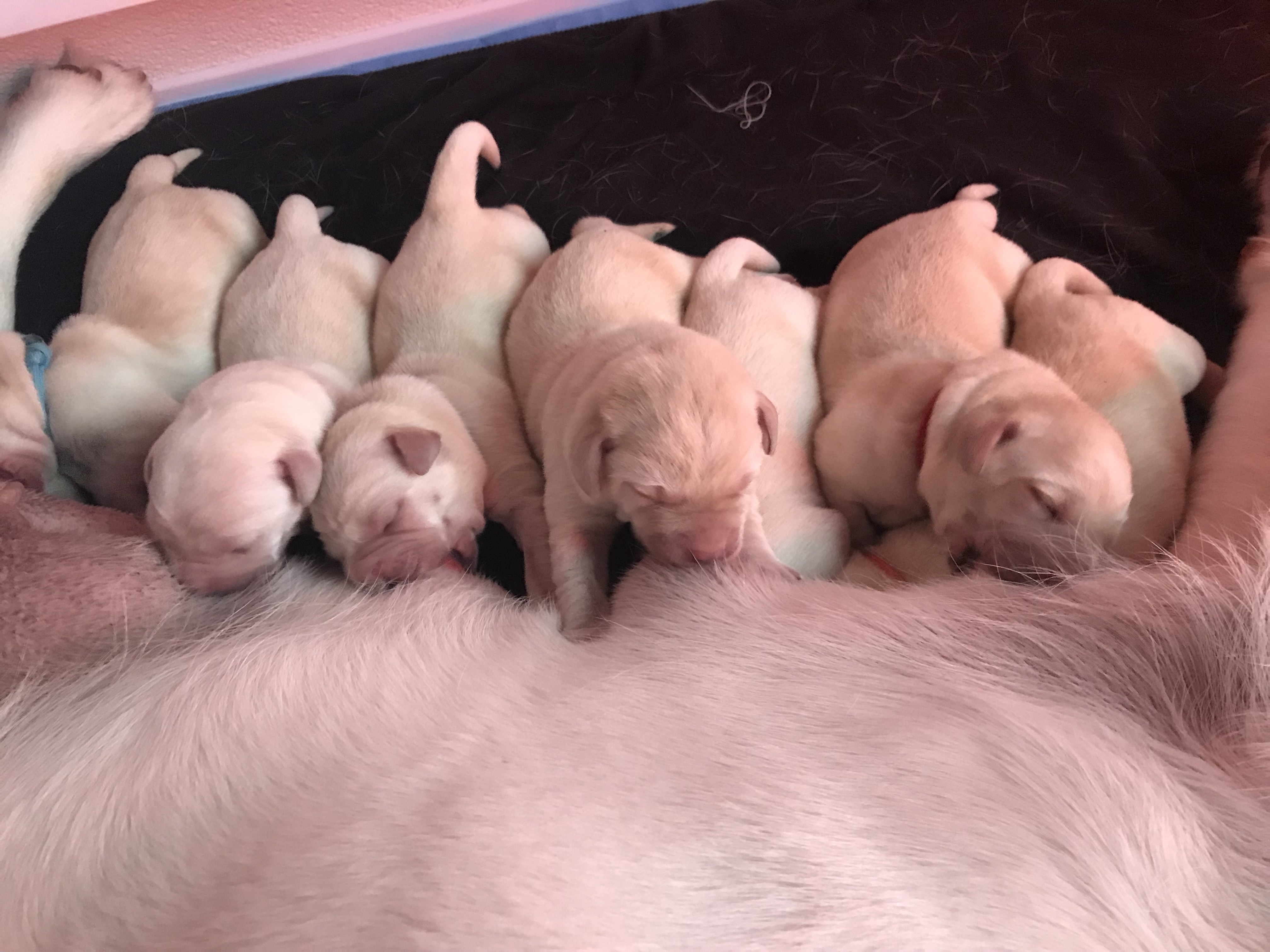
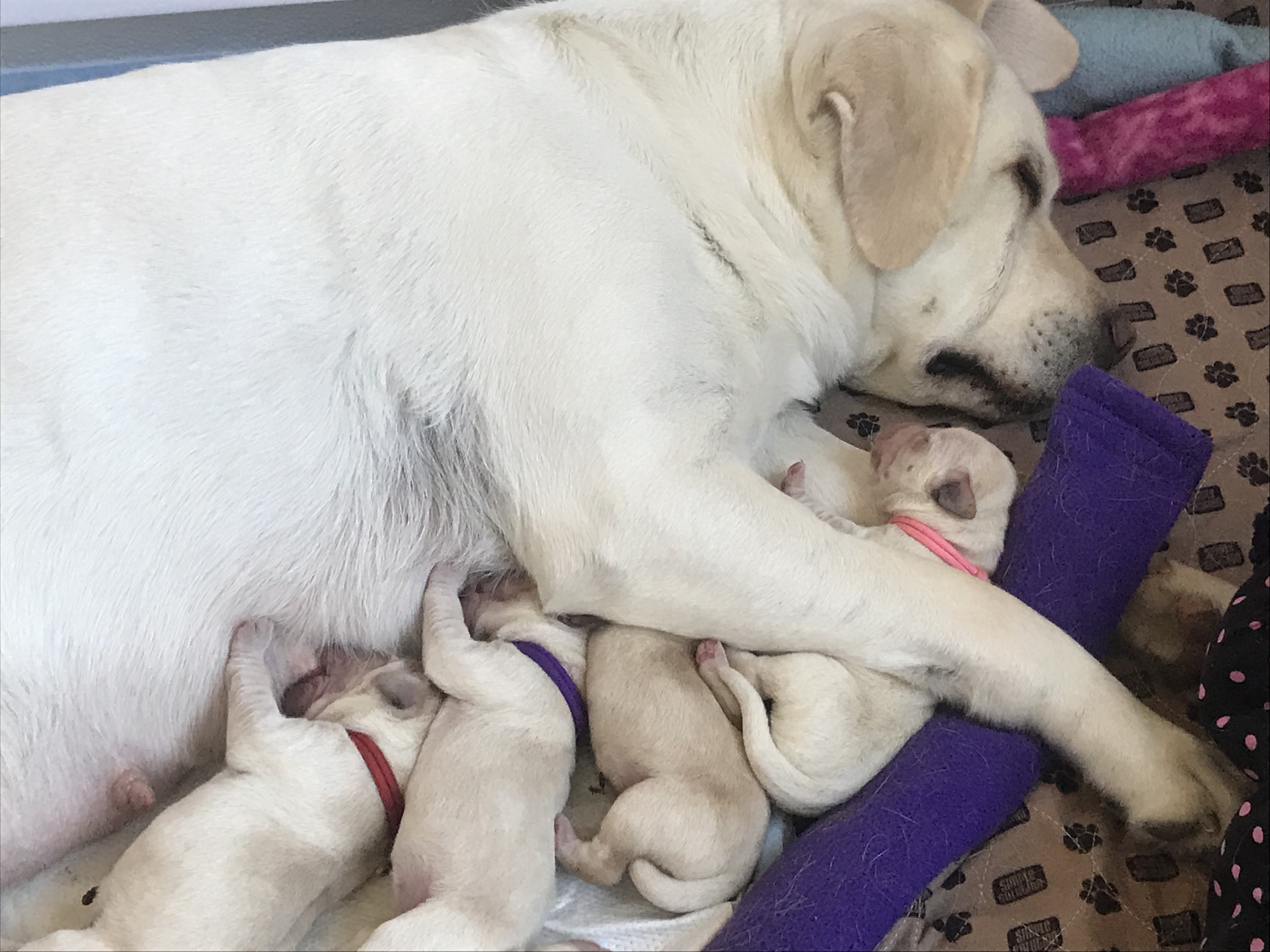
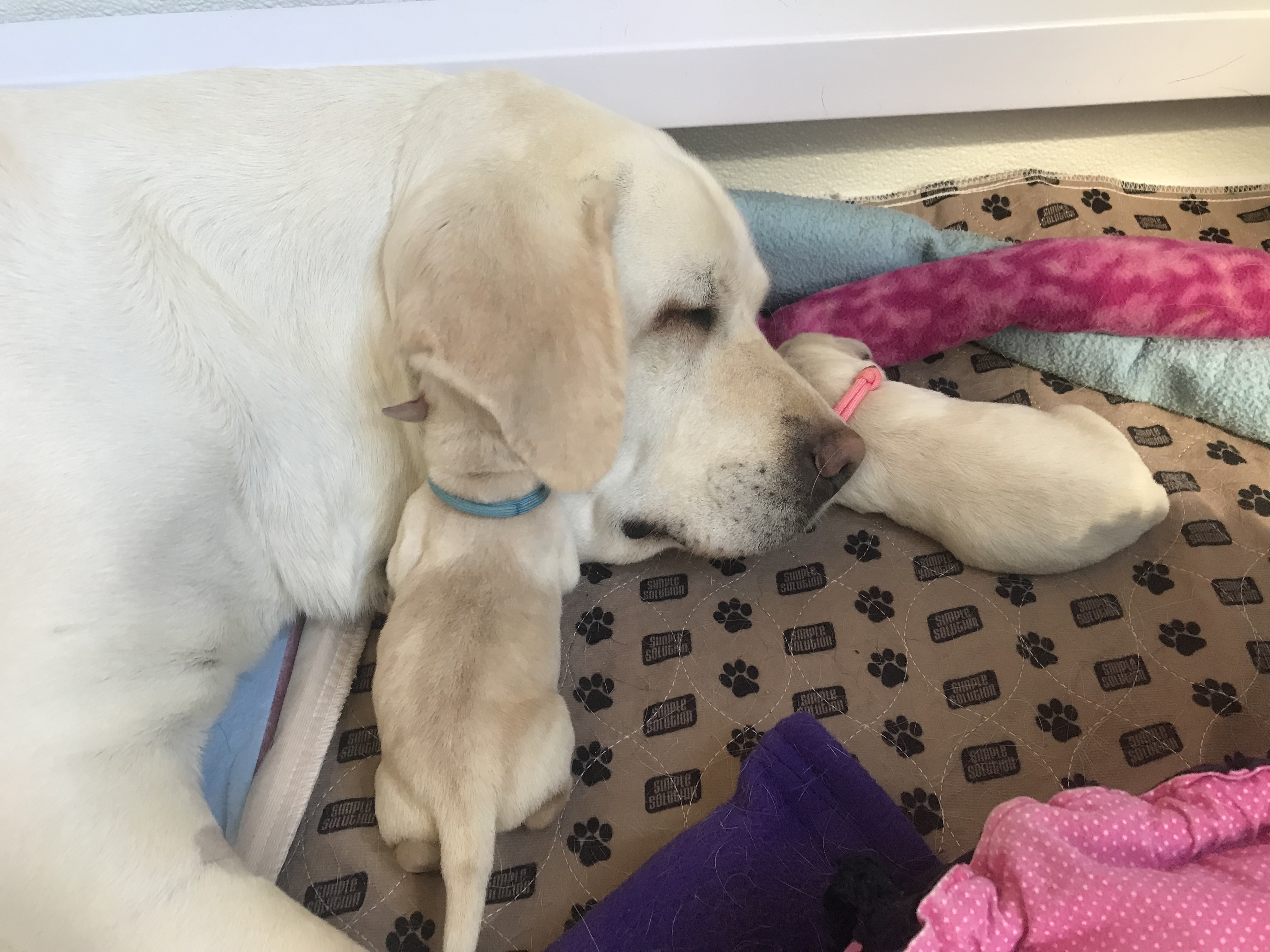
Day 15-You’re Never Too Young to Learn!

Once the puppies eyes open and they are reacting to noise, it’s time to add enrichment to their living space!  This is one of my favorite times because the puppies absorb things at such a rapid pace that you can barely believe what you are watching!

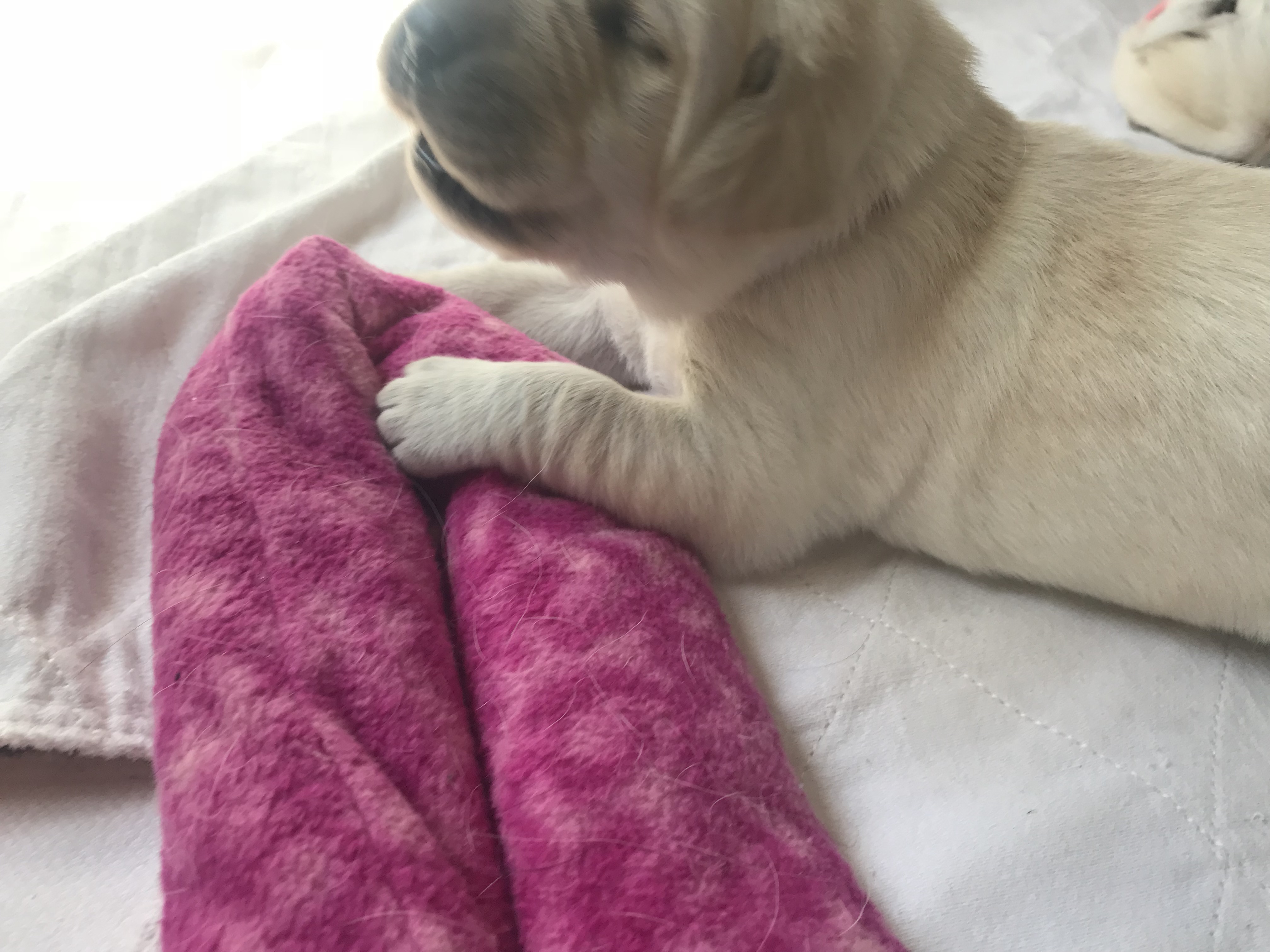
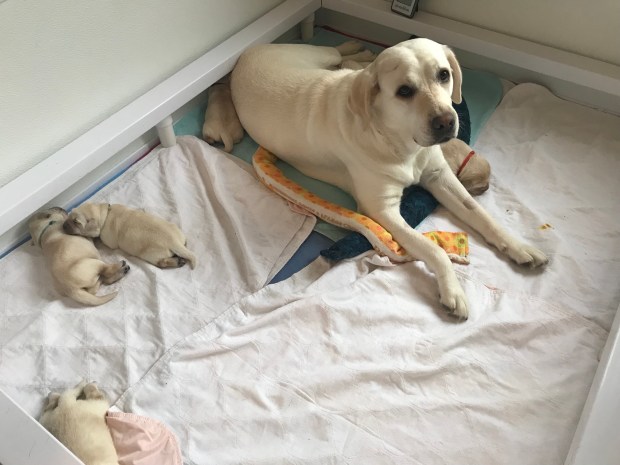
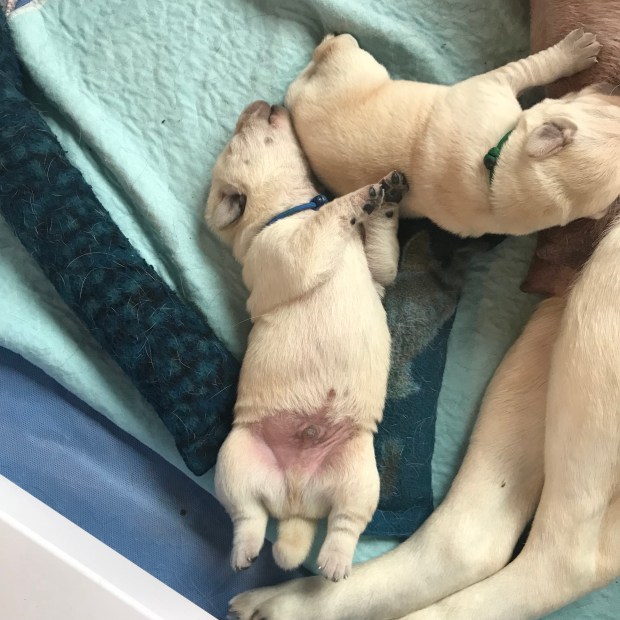
At this point, they are getting up on all four legs and walking (stumbling) around the whelping box; their eyes have only been open a day but you can tell they are already starting to look at things around them regardless of how blurry it might be; they are startling at noises and lifting their heads when I come into the room and talk to them; and that just means they need some opportunities to interact with colorful objects and they need to continue building their motor skills.

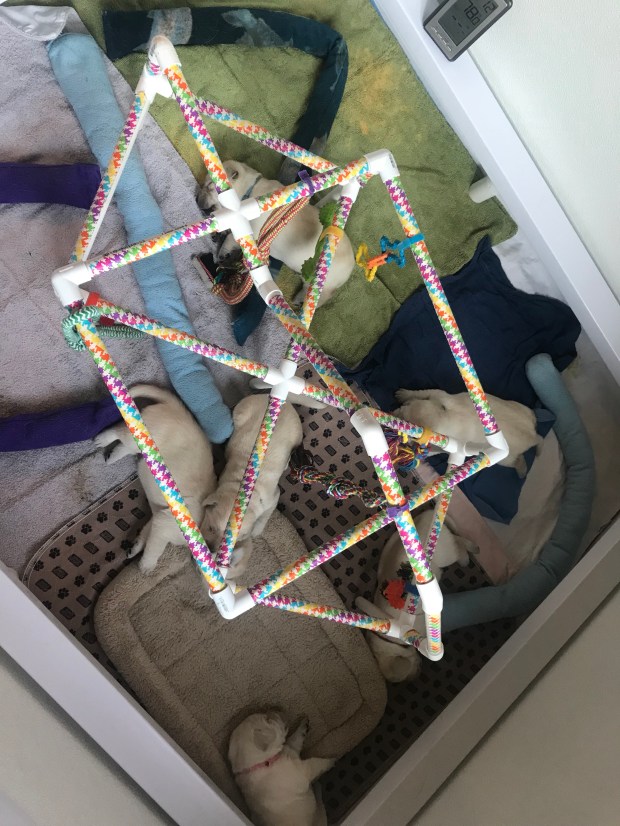
 

Throughout the day, various items get added or removed to encourage brain stimulation-but during the night, toys get removed so they only have to worry about getting rested and ready to learn again the next day!

So now they get some additions to the whelping box!  They get the puppy play gym-I intentionally made it with lots of colors so it was bright and enticing and I fill it with a variety of puppy and baby toys.  They will crawl all around it, under it, through it and as they gain play skills they will stop and chew on the different items because they will seem too irresistible to pass by!  This will help them in many more ways than just having toys to entertain them.  The brain enrichment that they get from adding things to their living space will help build them into confident dogs that will want to explore and not be afraid of their surroundings.  As they grow, every few days new items will be added to their living space including a ramp, a wobble board, various flooring surfaces, noisy toys, a slide, and a myriad of other items to keep their brain learning and developing!


This is a critical time for neurological development and all of the things that they are able to do during these initial puppy weeks build the foundation for a solid dog that’s happy, confident and willing! The variety in flooring pads that create different textures to crawl on, the tube snakes, the puppy pods, the puppy play gym – all of these items may seem like no big deal, but they are all part of the big picture of creating happy and well adjusted pups that will be able to take in the rigors of training to be assistance dogs!

I have to admit, knowing that every moment during these weeks in my home can help change the physiology of these puppies’ brains is pretty amazing, stressful and unbelievable!
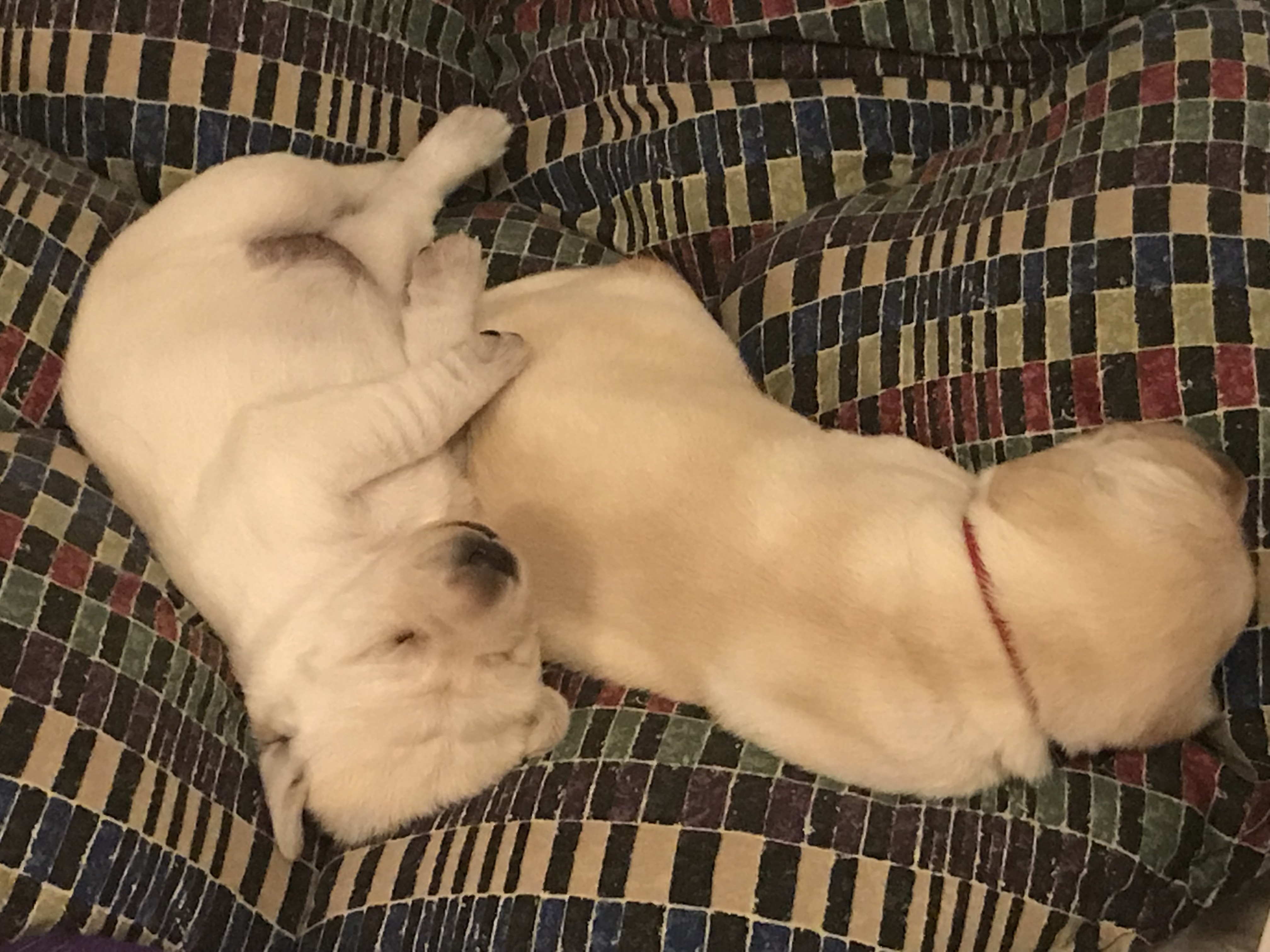


Of course, there is science to back up what we offer the puppies from the very earliest stages!  And while I am sitting in the whelping room keeping an eye on the beautiful puppies that I get to do my very best to build a solid foundation for,  my mind decides that I have to learn a bit more about the research on how to create a complex environment for the puppies so that they have the very BEST start they can have!


Here is some of the information that I read about and that I implement in the living spaces for the puppies while they are in my home:

They found that the dogs reared in the more complex home environment not only learned faster but seemed to be less fearful and considerably less stressed in the testing situations.

Over the years researchers have proven that these behavioral changes are the result of actual changes in the physiology of the animal’s brains. The brains of animals that have lived in changing and complex environments actually become larger.

New connections develop between existing neurons in the cortex as a result of experience. Recent evidence demonstrates that it is even possible to grow new neuralcells in important areas of the brain that are associated with learning, memory and the organization of behavior.
The important aspects of the animal’s experience which cause these positive changes in their brains involves exposure to a wide variety of interesting places and things that novel, and exciting experiences. It is best when these are combined with frequent opportunities to learn new things, solve problems and to freely investigate, manipulate, and interact with objects and environmental features. The data is unambiguous in showing that this leads to individuals who not only tend to be more inquisitive and are more able to learn quickly and perform complex tasks, but also who are less fearful and emotional.

Recent research by psychologist Norton W. Milgram and his associates at the University of Toronto have shown that the benefits of such experiences are not restricted to growing puppies. Adults and even elderly animals, not only benefit from having richer environments, but these problem solving experiences seem to help to offset the usual decline in mental efficiency that is seen in older dogs.

So, if you are interested in reading more from the article by Psychology today including some of the research, clink on this link to find out how you can continue to work with dogs and build their brain power even after they are out of the puppy stage!

Building a better brain for your dog – Psychology Today Research

Here is an excerpt from a website about the first 7 weeks of a puppy’s life:

First 4 Months of Age

The Imprinting Period

Imprinting PeriodLike children, puppies have a small window of time during brain development when they are most impressionable. This is called the imprinting, or critical learning period.  For puppies, the imprinting period is during the first 16 weeks of life. Puppies learn more during this time than they can learn in a life time. Therefore, the quality and quantity of what they experience will have a huge impact on their future personalities and determine the formation of many of their “good” or “bad” behavior tendencies. In fact, such vast change in development happens with each day that passes, the Imprinting Period is further sub-divided into multiple distinct puppy-stages.

First 7 Weeks

(Neonatal Period, Transition Period, and 1st Socialization Period)

In the first 7 weeks of life, puppies gain use of all the senses, become mobile, start growing baby teeth, transition to eating solid foods, and become completely weaned (independent) from their dog moms.

Learning is already rapidly occurring, making it important that human caretakers provide puppies with specific neurological stimulation, a complex environment, and careful, yet thorough, socialization for proper development and adjustment to living in human society.

Excerpt taken from the following – http://wonder-puppy.com/puppy-stages

Day 14-Oh, say can you SEE!!!!

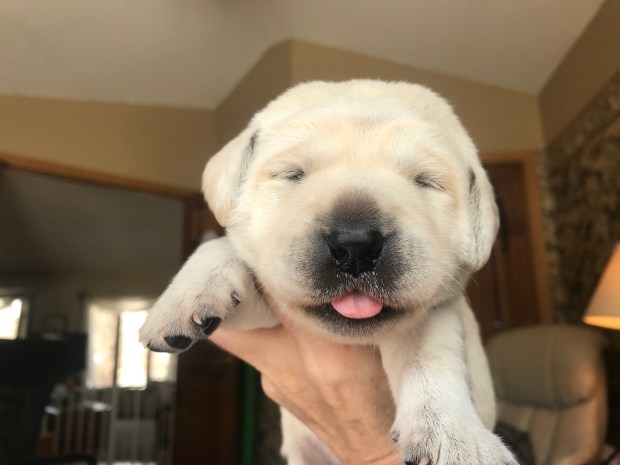
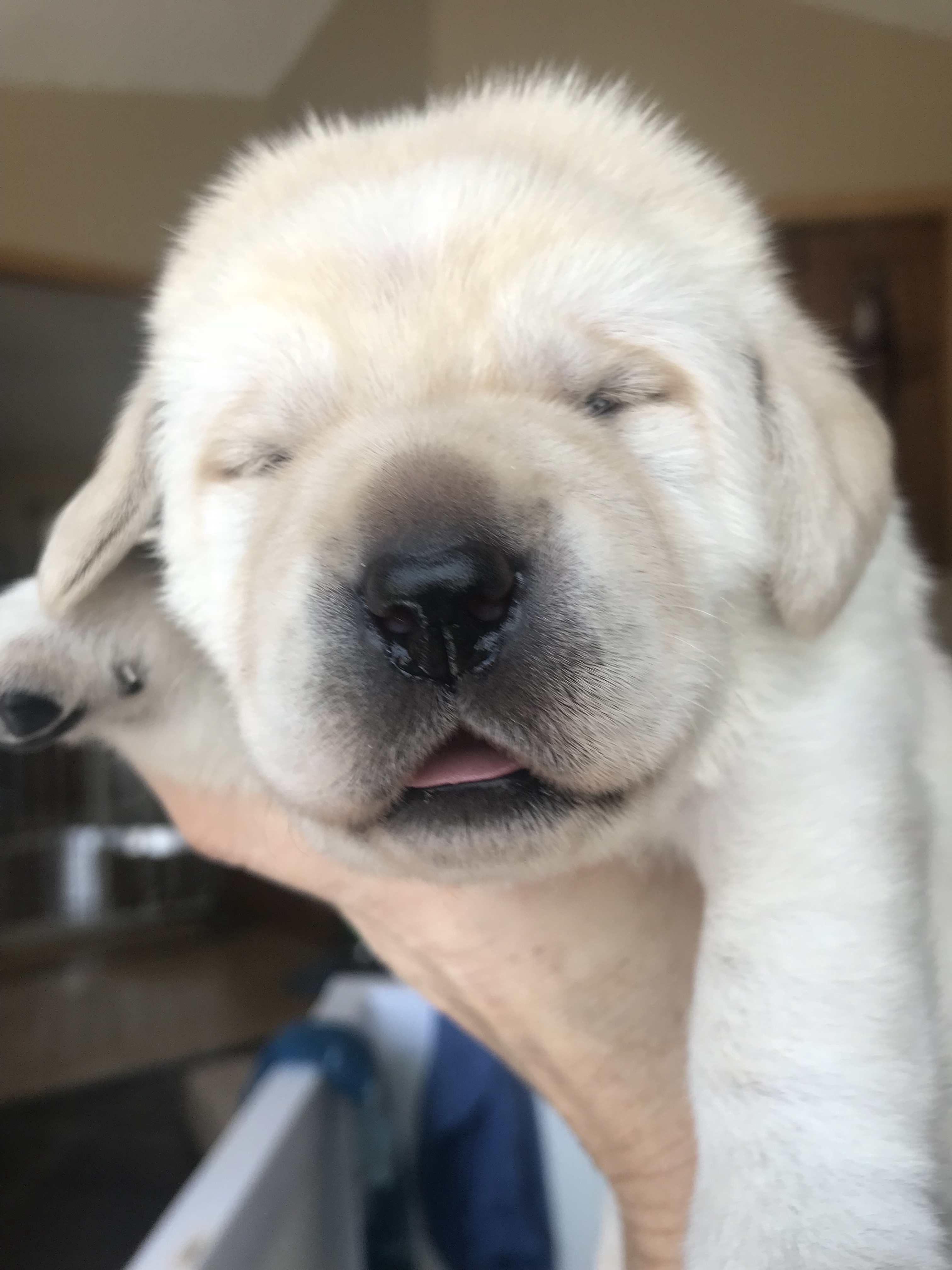
Well, the puppies have been working on it for a couple of days now, but this morning in a matter of TWO hours 3 puppies have opened their eyes!!!! Purple, Blue and Orange!!! I completely suspect that by the evenings close all puppies eyes will be open and they will start exploring their new world!

Their personalities are really starting to shine as well!

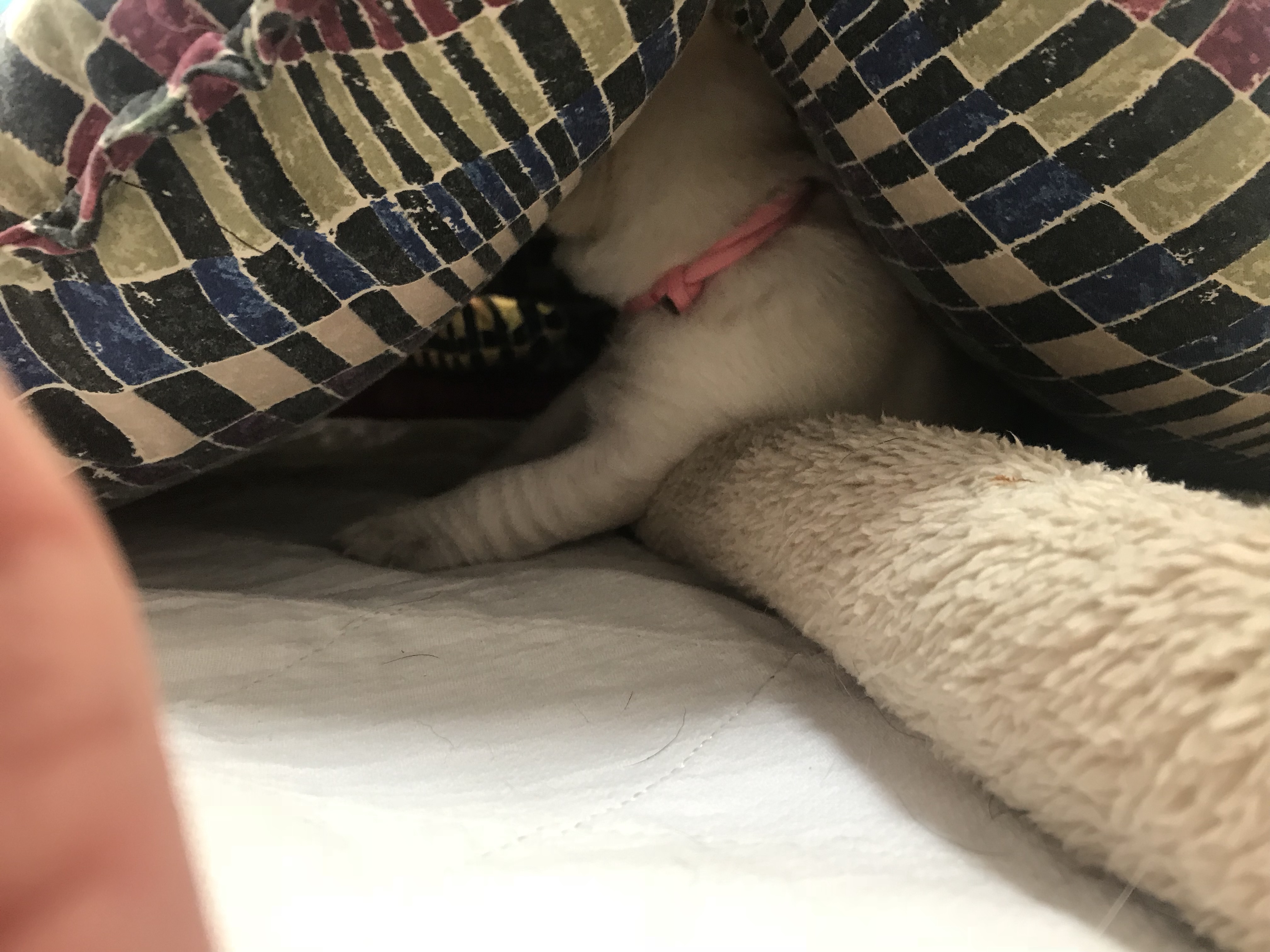
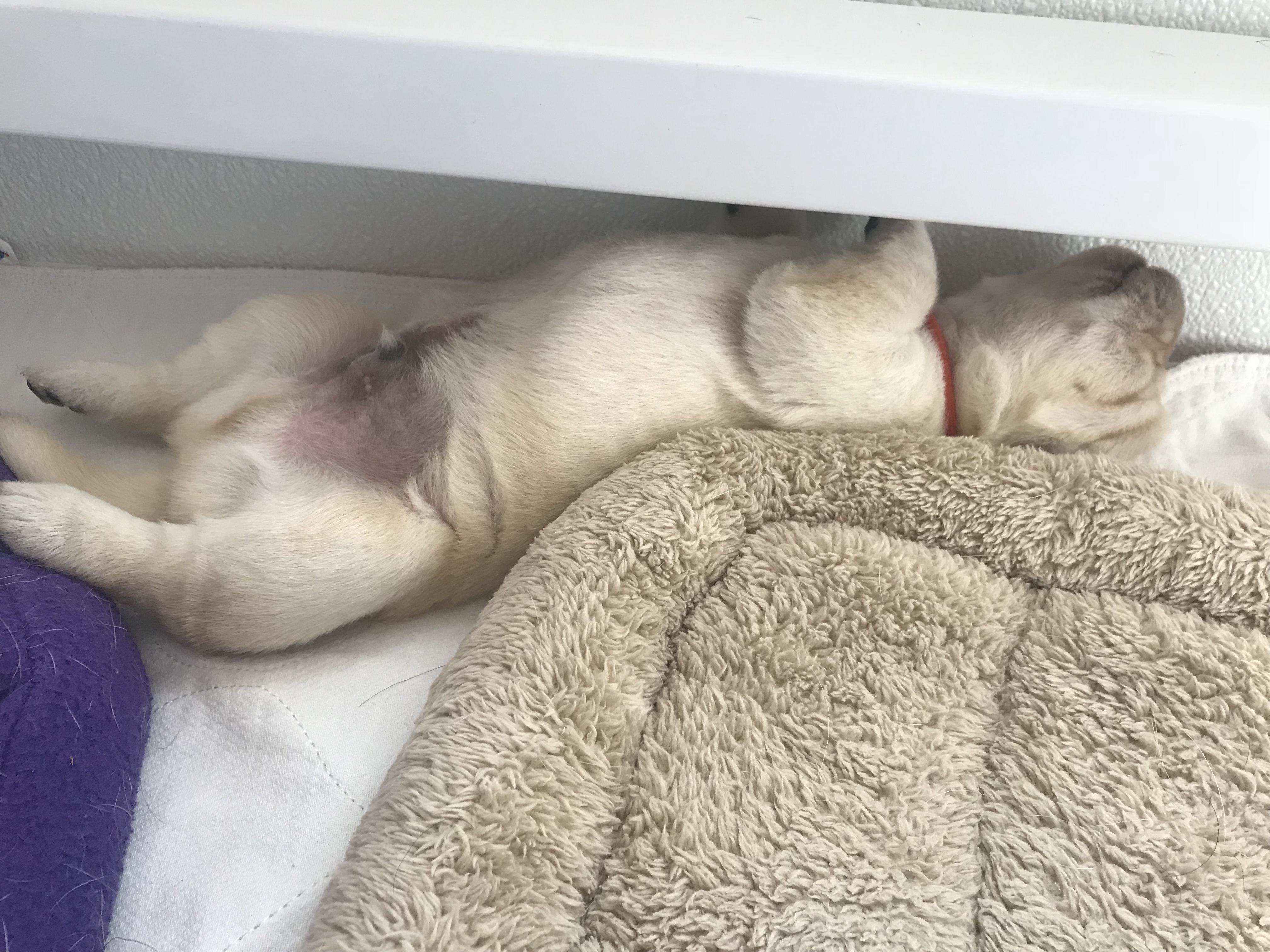
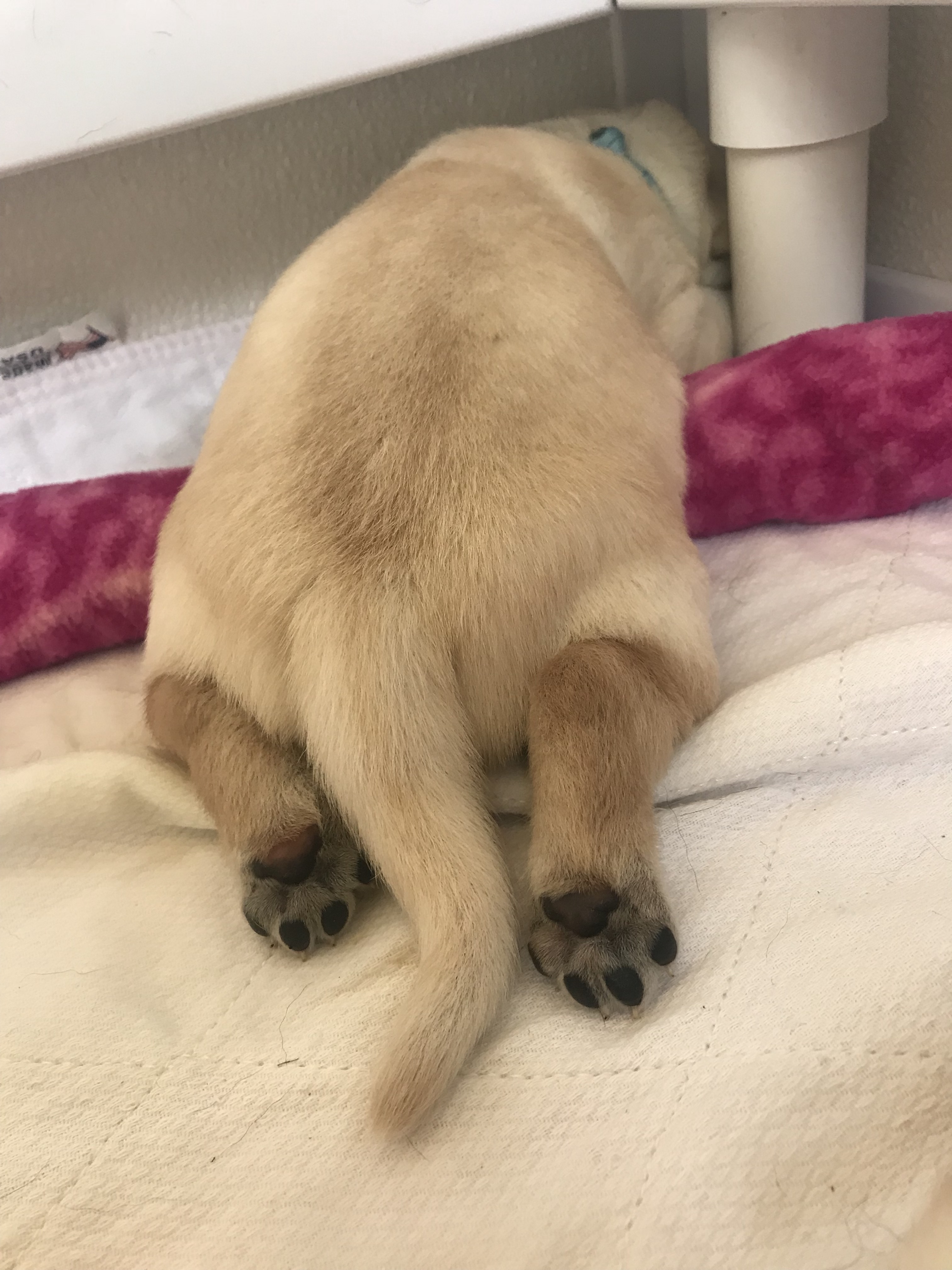
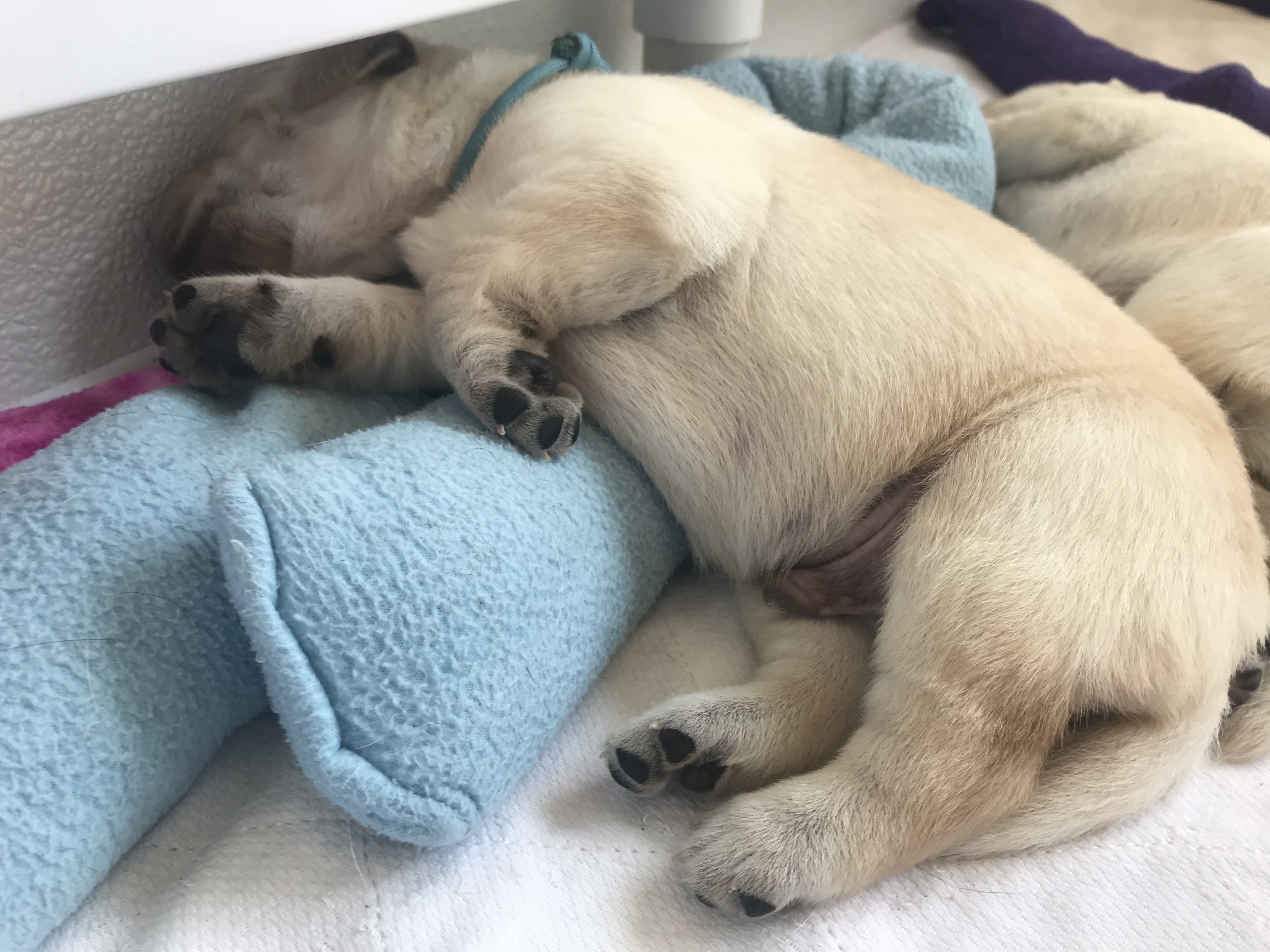
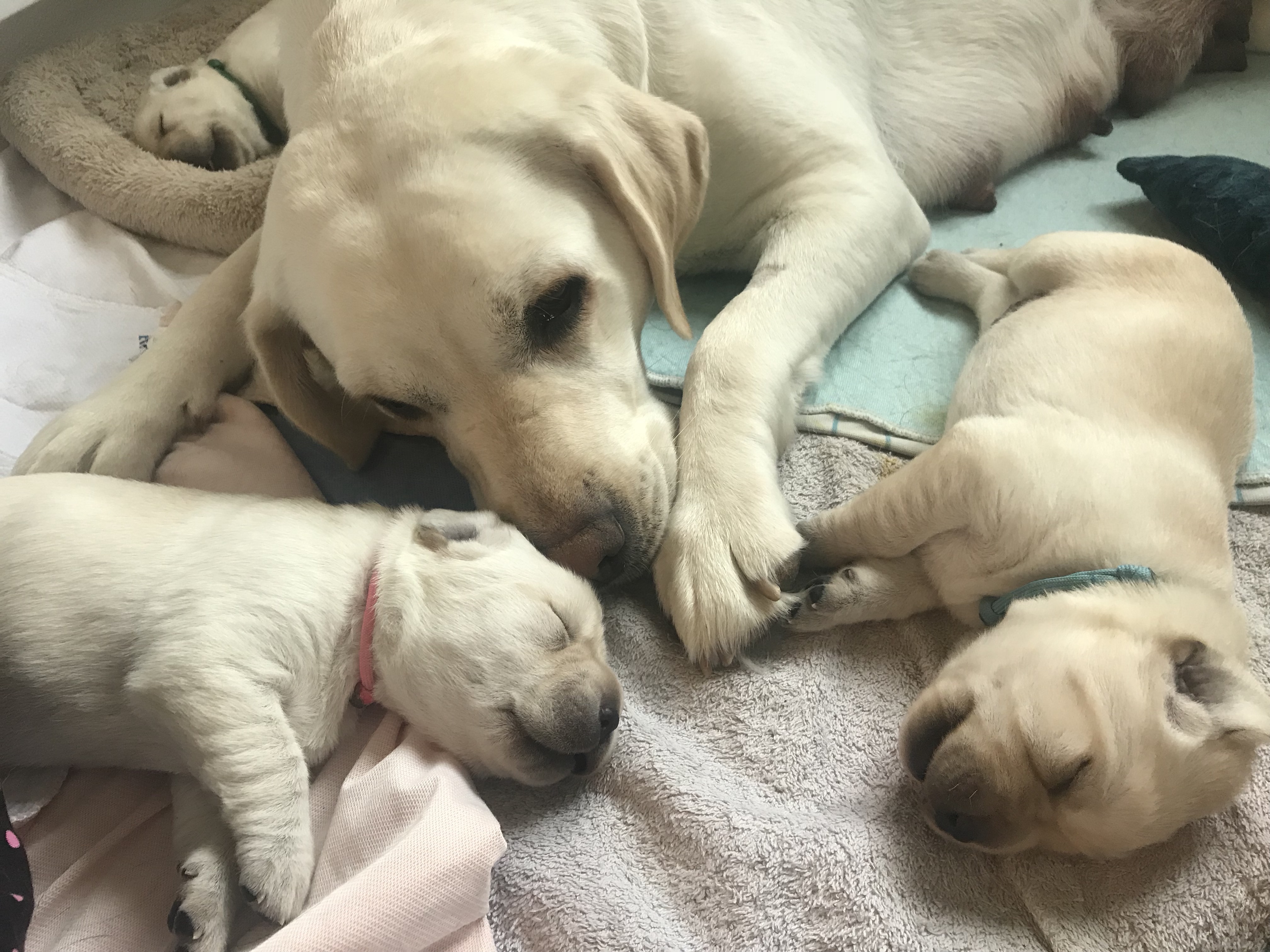
Miss Pink is the sassy one (why is it that Pink collared girls are always the sassy ones in the litter?????) She’s independent and fierce in her opinions about her unhappiness with the bio-sensor training, letting me know that she REALLY doesn’t think that I should be maneuvering her body the way I do and that Q-tips in the paws should be outlawed! Ironically enough though, she is the snuggly one who is always scootching up to her siblings to sleep with them, preferring company over being alone. She also loves sleeping UNDER things, and I am constantly doing a head count looking for her before I step into the whelping box! But by far she loves snuggling with her Mama Sugar the most!


Miss Purple loves adventure!  She is the first one to follow the tube snakes in the whelping box to get to another destination completely on the other side.  She navigates puppy pods, the snakes, and fellow siblings to make her journey in record time! She seems to already be a problem solver and I can’t wait to see how she progresses!  She’s fabulous at her bio-sensor training, I’m guessing she’s figured out the quieter she is when I’m doing it the quicker it will get done!


img_3236

Miss Purple trying to focus so hard her tongue fell out…..


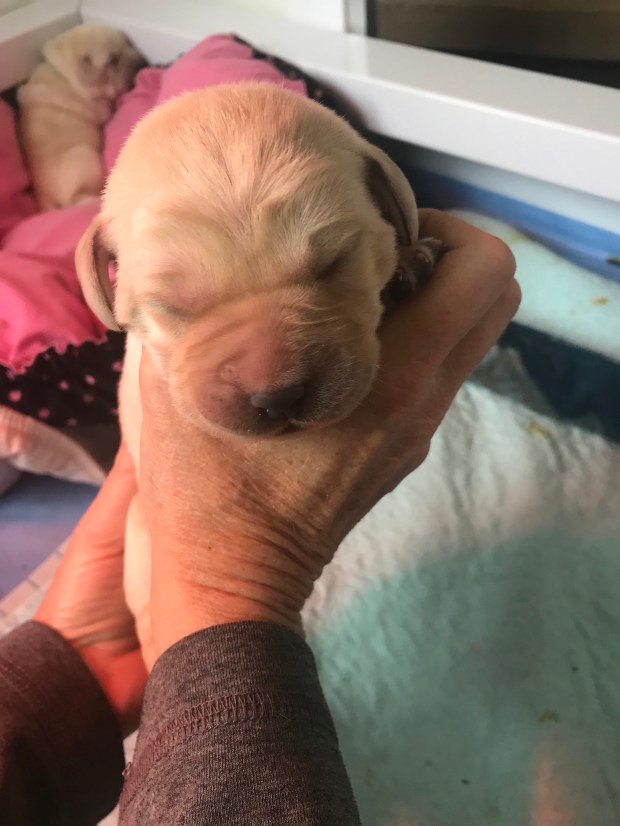
Mr. Blue is our rock star-literally!  His hair on the top of his head is shorter and spiked and when you look at him he looks like a rock star from the 80’s! (see photo below) He is super friendly and quiet, and he seeks out humans for attention already!  He loves to snuggle in my arms and when I talked to him this morning he wagged his tail for the very first time!!!! It was a heart-melting moment to be sure!  Of course, I gave him extra snuggle time for that!

Yes, I know-my spiked hair is a chic magnet….Rock On pupsters…..

Mr. Red is apt to use his voice to show her displeasure:)  He also loves to snuggle with the tube snakes, preferring to have his head lifted off of the ground-he will even use a sibling if necessary! He’s more independent, and he’s the one most likely to sleep through feeding time:)  And Red is very particular about the whelping box climate; he wants it between 74-77 degrees, no more, no less. If it’s outside of HIS comfort zone I have to adapt his sleeping space-like today when I had to put a cool towel down for him to sleep on because 78 degrees just wasn’t acceptable….

Mr. Red trying to stay cool as the whelping box didn’t meet his 3-degree range of expectations….


Mr. Orange is the one who will NEVER miss a feeding! He will climb THROUGH his siblings to get to the milk bar and nothing stands in his way! That makes total sense because he was the heaviest at birth and he still holds the title for heaviest pup in the litter!  Orange loves to find a tighter space, and roll on his back to sleep. (Probably to rest his belly!) He isn’t quite aware of his size, so when he tries to stand up, walk, or crawl it’s sure to make you laugh. I can’t wait to see this big boy grow!

Orange Resting his belly to be ready for the next feeding time!

Mr. Aqua is a sweet, sensitive, snuggler.  He likes a quiet whelping box and he loves hiding in the corners.  He loves to snuggle with Miss Pink and they seem to make a concerted effort to find each other in the box, going around other siblings and stopping when they get to each other.  He’s an active dreamer and his legs make me think he is doing a lot of running in those dreams!


Mr. Green is the unassuming one. He goes with the flow; Bio-sensor training now? ok, whatever…..whelping box change, sure………feeding time? “Hey, I’ll get around to it when my nap is over” type of attitude.   Green loves the puppy pods and the cat bed for his naps. Nothing seems to stress him at this point so it will be fun to see his personality change over time!


They are really REALLY fun to watch and I’m amazed that they are so different already at 2 weeks old! What’s even more amazing is that they were showing signs of these personality traits as early as a couple of DAYS old!  Of course, that immediately makes me want to research puppy development even more….


Those eyes are working hard to focus!

And just in case you wanted to know more about puppies and their senses developing, here’s some of the science behind the last two senses to develop in a puppy….

According to a variety of veterinary websites, here is the basic information about their last two senses to develop and how that is part of the canine evolutionary process:

Puppies lack two senses at birth: sight and hearing. It takes a minimum of 10 days to two weeks for their final two senses to develop. Although lacking their sight and hearing might seem odd to human beings, puppies develop in a way that is advantageous to their species.

Eye Development

Puppies’ optical nerves are developing along with the rest of the central nervous system, making them very sensitive to light. In addition, the eyes themselves are still forming behind the lids. Sealed eyelids protect the nerves and membranes of the delicate organs from hazards such as light or grit. Once the eyes have fully matured, puppies’ lids start to open.

Appearance

Newborn puppies bear little resemblance to adult dogs. They have massive heads with pronounced muzzles suited to nursing. Their legs are short and possess only enough power to scoot their bodies along the floor or ground. Newborn puppies cannot stand. Neither can they hear; their ear canals remain sealed shut. Finally, they cannot see because their eyelids are also sealed. 

Dogs as Predators

According to Stanley Coren, Ph.D., this helplessness makes perfect evolutionary sense. Newborn herbivores emerge fully functional after their mothers’ long pregnancies because they have to be able to run with the herd, in part to escape predators. However, long pregnancies would interfere with predators’ ability to hunt and to survive. Puppies continue to develop after leaving their mothers’ wombs because doing so is in the best interest of the canine species in terms of survival.

The Nervous System

Puppies’ central nervous systems are incompletely formed when they are born. The brains, spinal cords, and nerves are all present in their bodies, but the nerves cannot transmit electrical impulses in an efficient way because they have not been coated with enough myelin yet. Myelin is the fatty layer that carries messages along the nerves. In normal, healthy puppies, the myelinization process takes several weeks, after which puppies can make more purposeful movement.

Day 12-Developing at the Speed of Light!

Oh.my.gosh. I blinked for what seemed like a moment today and all of a sudden these “kill you with cuteness” puppies decided that crawling was too easy, so they got up and started walking all over the box!!! Mr. Green is the first one today to try to engage in play with a sibling by chewing on another pups paw, and their eyes noticeably continued to darken and they have blinking reflexes! I bet their eyes will be opened by tomorrow morning!!!! Purple is leading the pack and I hope I will get to see her beautiful eyes in just a few hours!

Tomorrow should continue to see more incredible developments!!!!

Miss purple is getting ready to open her eyes and see this big, beautiful world for the very first time!


So many developments today it’s crazy!!!

Sometimes you have to work extra hard to get your mom’s attention!

You can see a whelping box full of obstacles-or opportunities for growth!

The puppies have created their own buddy system, snuggling up in the same pair combinations day after day!

Day 8-What Blizzard? It’s Sunny, Warm, and 80 Degrees-At Least in the Whelping Box! (Perspective is Everything)

THE GLIMMER OF POTENTIAL BEGINS TO APPEAR

As you can see by the picture below, it’s hard to remember it’s spring right now……

img_2878-1

But perspective is so important!  We may not be having the nicest weather currently, but hopefully, everyone will be able to settle inside somewhere and enjoy some good music, television, family time or just catching up on their to-do list.  This won’t last forever….at least that is what I keep telling myself day after day after day…… 🙂

Perspective is also important when it comes to assistance dogs. There are all sorts of storylines regarding assistance/service dogs in our everyday world-from those who make training service dogs much more difficult because they try to pass off their pet as a service dog, to those who ask us questions about if assistance dogs are happy and ever get to “just be dogs”, to the dogs who have “made it” and are happily serving clients all over the world, changing their lives and wagging their tails! And let’s not forget the dogs who started in the journey of becoming an assistance dog and for a myriad of reasons were unable to complete THAT journey, but have gone on to lead wonderful lives of purpose as comfort dogs, therapy dogs, and precious pets. The great thing about dogs is that they change lives everywhere they go, and it’s not limited to those in only in the assistance/service dog world! They are truly amazing, and if you haven’t had the opportunity to see that then just take time to stop and observe one day and watch the dogs around you. They read their humans like no one can; they adjust to the changing world around them that’s out of their control with a calm stride and they make others laugh and smile-sometimes they are the only ones that can do this with such little effort!

People ask me why fake service dogs are a problem and I talk to them about how poorly behaved dogs that aren’t qualified to be out in public give ALL dogs a bad name in public places, not to mention the safety factor which is unfair to the dogs who aren’t adequately trained to be in all of those situations as well as the humans who encounter them.  Just like you wouldn’t pay an untrained person to be your doctor or fix your furnace due to safety issues, having people who aren’t trained to handle public situations with dogs is a recipe for disaster in my opinion. Dogs that are put in environments that they haven’t been exposed to regularly can suffer from stress and anxiety, and that can lead to a bad reaction or interaction in a crowd.  One bad experience with a fake service dog that you think is a legitimate service dog will taint the viewpoint of how these dogs serve clients in public spaces.  The more issues that people and businesses encounter with fake service dogs, the more they question us volunteers about the dogs we are training in public. That’s exactly why it takes assistance dogs 2+ years to get enough experience and training to be successful in their careers and that’s why it’s so frustrating for fosters, puppy raisers and volunteers to have to endure the increased challenges of justifying why we have the dogs we are training out in public.  If assistance dogs in training don’t have the opportunity to get out in public and experience all of the things they will need to know about before they go into service, this can decrease their confidence and make them less able to perform their tasks as needed.

As for dogs in training “just being dogs”, I can assure you that the dogs in training that I have personally fostered, short or long term puppy raised or have been a breeder host for have more opportunities, more fun times of play, more one on one attention, more toys (just ask my husband how many baskets of dog toys he begrudgingly has to tolerate in our living room) and more “just being dogs” than other dogs I have owned in my entire life!  We experience life as a TEAM, and they get to enjoy things with me that I never got to enjoy with my own personal dogs.  Movies, restaurants, cafes, parks, buses and light rail, pancake breakfasts and the list goes on!  They’ve allowed me to see the everyday things in my life from a completely different lens and my perspective has changed in ways I could have never imagined!

When I had ankle surgery and was in a wheelchair and on crutches for 4 months, I realized how difficult it was to get places, how hard it was to open doors and how every task for me seemed so much more difficult to accomplish.  I also realized that people are so busy in their lives that sometimes they don’t take the extra few seconds to help someone around them-not wanting to “offend” them by offering help or they are just too busy to stop. But when you watch clients with assistance dogs, part of the difficulty in some tasks gets removed but their companionship also provides comfort, and these dogs draw a great sort of attention that makes people react differently which is so incredible to watch!

And, don’t ever feel TOO bad for a career changed assistance dog; their lives are full of people who love them, families who play with them, and opportunities to continue changing lives!  Many become certified therapy dogs and bring joy to another whole plethora of people!

So, on this blustery winter day, my suggestion is to change your perspective, and feel the warmth of these puppy pics-and just TRY not to smile!!!!! Feeling warm inside from the cuteness of these adorable puppies is a pretty good alternative 🙂

Miss Pink-I just call her heart stealer……

cuteness overload!  Check out the extra skin on the leg of Mr. Red-he’s sure got his Mama Sugar’s extra skin gene!!!!

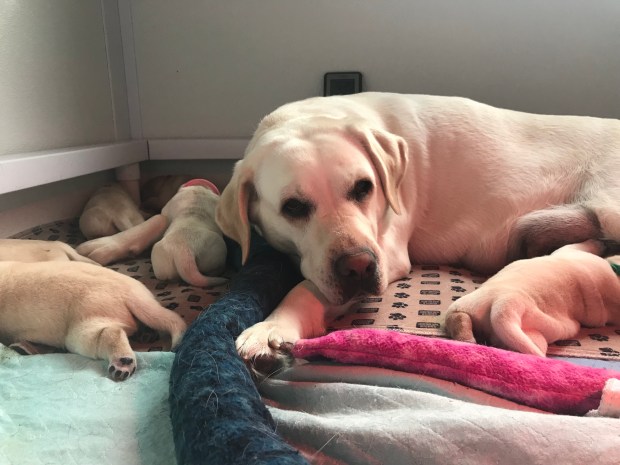
Sugar just relaxing on this cold blustery day with her beautiful pups!

Mr. Blue getting comfortable

NOW he’s comfortable!

A little snuggle time with Miss Pink

Glimmer

Day 5: The Gift You Can Only Give Once-Puppies of Purpose Have a Busy Schedule Ahead of Them!

Many people love seeing Service/Assistance Dogs when they are working with clients, but often don’t realize the work that has gone into those dogs over their entire lives to get them ready for the job at hand, and the work begins as soon as they are born.  As a whelping home for my first time in 2015, I was a bit amazed at everything that these puppies are exposed to in the early days of their lives which research has proven has a direct impact on how well adjusted they can be as an adult dog!  I also had to learn that holding and loving these puppies is critical, but it doesn’t replace the other things that puppies need to experience; new environments to experience and changing their environments to teach them to adapt to their surroundings, exposure to a whole variety of sights, sounds and smells, socialization with every possible opportunity once they are old enough (but at the very least with me and my husband handling them frequently until they can socialize with others) creating brain challenges for them to keep their neurological stimulation at its very peak so they can transfer that to becoming a dog that loves to work and help with tasks.

Here are the stages of these tiny pups and what they should experience in order to give them the perfect building blocks for success!
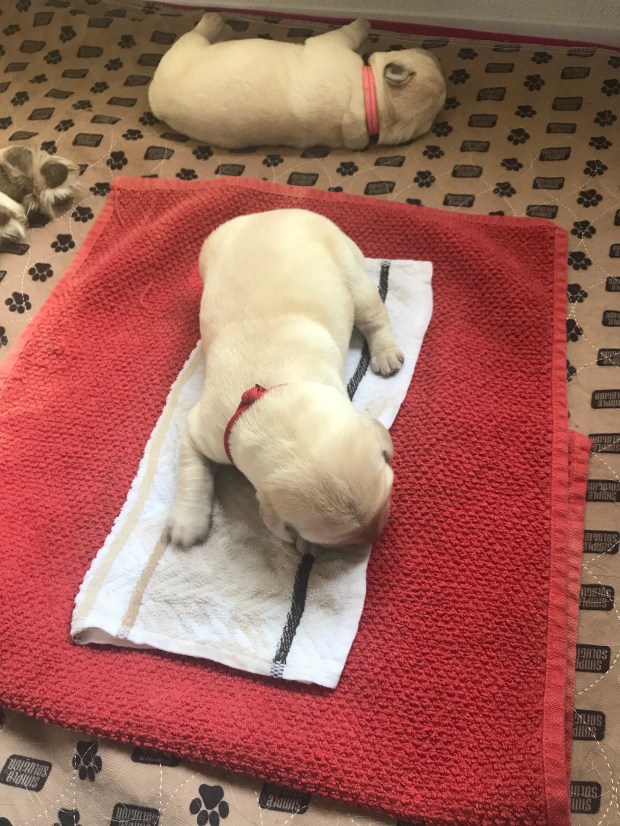
The excerpt below is taken from a Healthy Pets article by Mercola and does a great job of explaining the first 8 weeks of puppy development.

5 Milestones in Every Puppy’s Life

Stage 1: Whelp. A whelp is any just-born carnivorous animal. The word is most often associated with newborn puppies. Whelping means birthing; to have whelped means to have given birth.

Stage 2: Neonate. Neonate refers to a newborn pup from day 0 to day 13 of life. Neonate puppies can’t see (their eyes are still closed), can’t hear (their ears are sealed shut) and can’t pee or poop without stimulation (licking) from mom.

They have no teeth, nor do they have the ability to regulate their own body temperature.

These tiny babies depend on mom and their littermates to stay warm, which is why they tend to snooze in furry little piles. Neonates sleep about 90 percent of the time, and when they’re awake, they’re nursing.

Fortunately, they’re born able to smell, which helps guide them to mom’s nipples at mealtime.

The first milk a mother dog produces is colostrum, which contains the antibodies that transfer maternal immunity to help protect the pups from opportunistic diseases during their first weeks of life.

NEUROLOGICAL STIMULATION

Virtually all the energy a neonate’s body generates goes toward growth. They typically double their birth weight during the first week of life. Since they can’t yet stand, they sort of paddle around using their front legs. This soon leads to crawling.
It’s during this time (days three to 16) that its beneficial to institute early neurological stimulation (“super puppies,” as some say) which can oftentimes result in more balanced adult dogs.

The U.S. military did studies on raising puppies, and they found that doing certain exercises with puppies during the time of rapid neurological growth, between the puppies third and sixteenth day of life would increase the pups performance in later life. They created a program called the Bio Sensor program consisting of 5 exercises to be done once a day with the pups. They found that not only were puppies able to cope more with stressful situations, and problem solve better than other puppies, but that they were actually physically healthier with higher cardiovascular performance, stronger immune systems, adrenal glands and heart beats.

They are only done for a brief 3-5 seconds so as to stimulate the neurological functions without stressing them too much.

img_2727

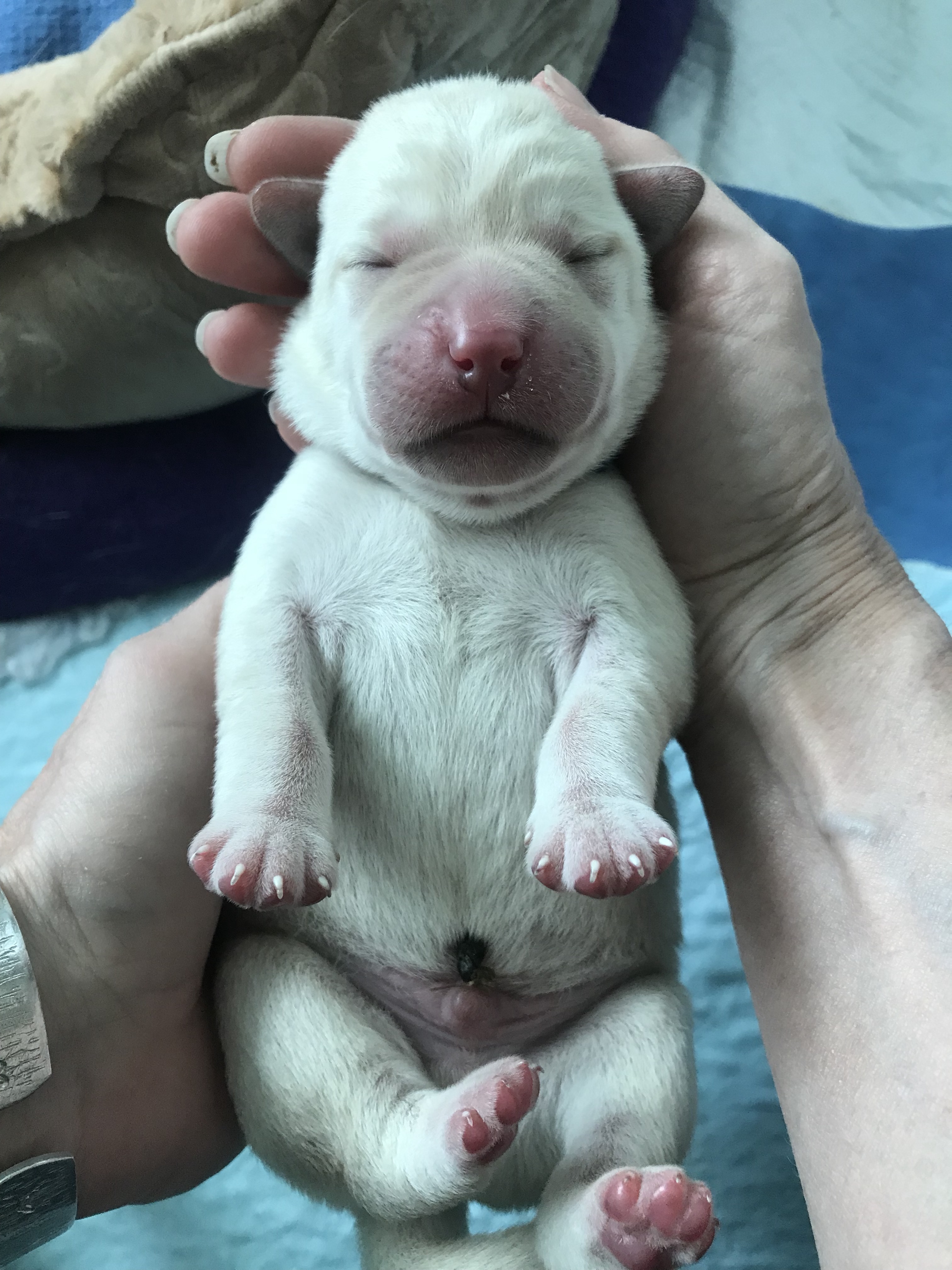
Holding them upright encourages neurological stimulation and blood flow
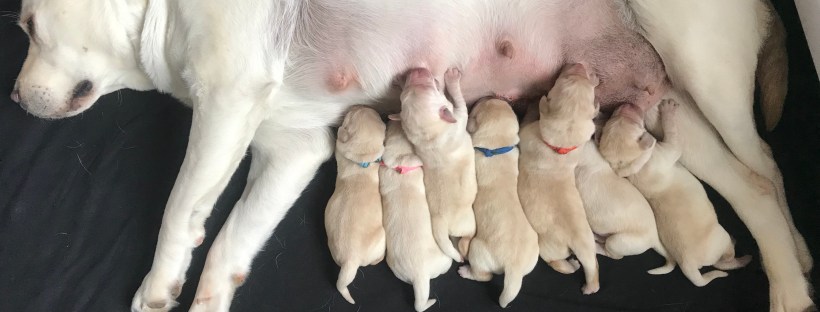

img_2728

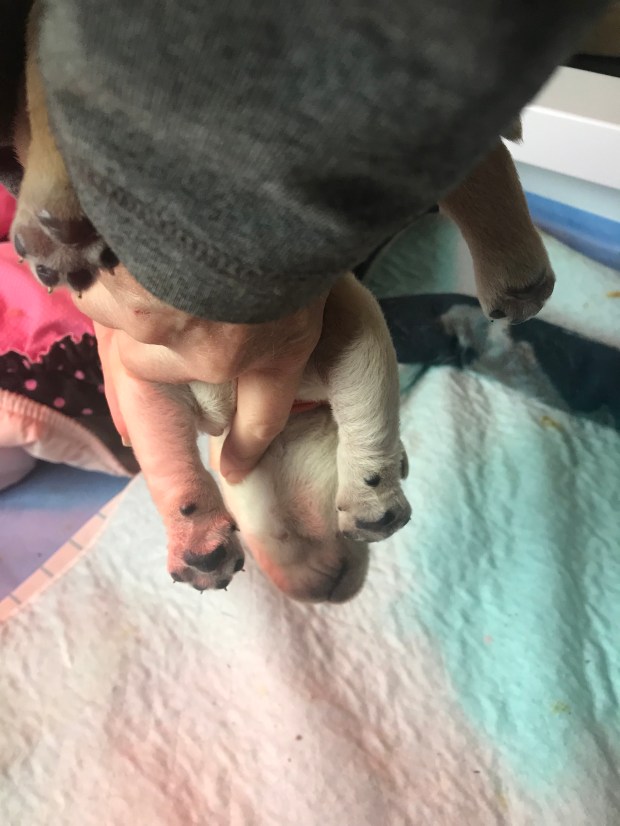
Holding them upside down for 3-5 brief seconds causes additional neurological stimulation which is different than when they are held upright!
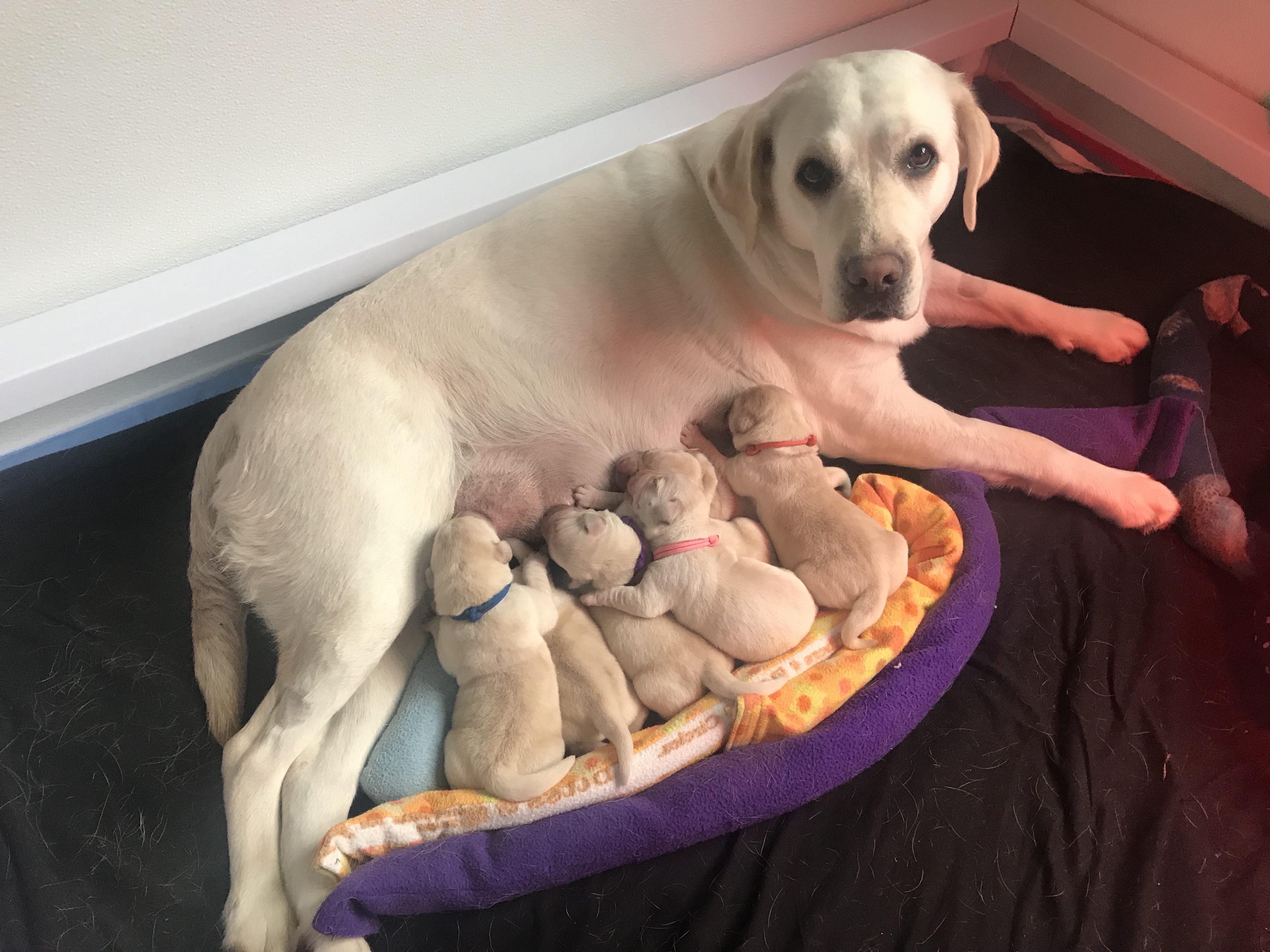

img_2724

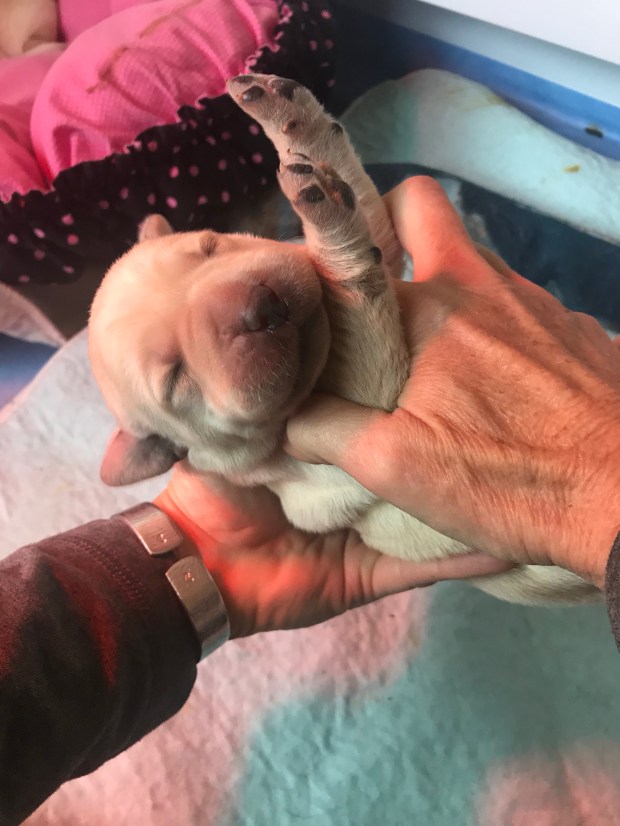
The supine position has them laying on their back or cradled-I can just imagine those brain cells developing as we go through these exercises!


img_2725

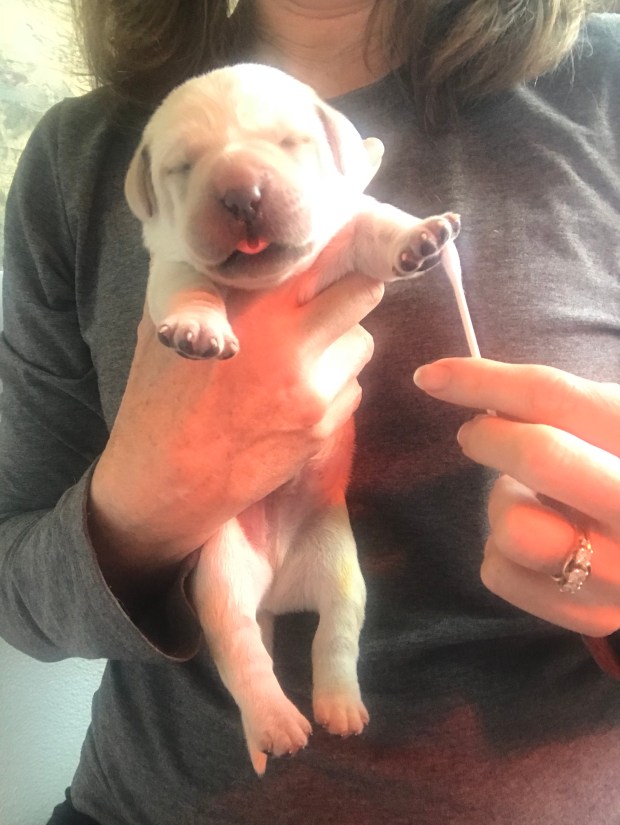
Using a Q-tip on the paws and between the pads is a tactile stimulation that can help them be adaptable in future situations where there is a flooring change, a different surface that they need to manipulate, etc. and keeps them learning to be adaptable to their surroundings


img_2731

Placing the puppies on a cool, wet rag briefly continues to stimulate the neurological connections that they will use as they grow into adult dogs!

Below is a video explaining neurological stimulation by a veterinarian.

Stage 3: Transition period. The transition period covers days 13 through 21 of a puppy’s life. The ears start to open at around day 14, and the eyelids between days 10 to 16. As you can imagine, these events give the pups a whole new outlook (literally) on their world.

They begin to respond to smells and tastes, and their little puppy grunts evolve to whines, yips and barks. By day 15, most pups are standing up, and within the next several days they take their first unsteady steps. At this point, they go from total reliance on mom to a bit of independence.

Stage 4: Awareness period. The awareness period is day 21 to day 28. By 3 weeks of age, pups are using their senses of sight and hearing to learn. They’re beginning to play with their littermates and explore their environment.

This is also the time during which puppies gain some control over elimination and begin moving away from their “den” (sleeping area) to pee and poop.

Stage 5: Socialization period. The initial socialization period encompasses weeks 3 to 8 in a puppy’s life. It’s during this period that her interactions with other pets and people increase, and she’s able to form attachments.

At about 4 weeks of age, mom’s milk production begins to taper off, and the puppies’ calorie requirements increase. As mom gradually weans her pups, they begin showing serious interest in solid food.

As luck (and more importantly, nature) would have it, at 3 to 4 weeks, the canine teeth begin to push through, and a full set of puppy teeth make an appearance between weeks 4 and 6.

Age 6 to 8 weeks is considered a critical time in every puppy’s socialization period. This approximately two-week window is when puppies are most accepting and least fearful of others.

How quickly a pup’s mental development occurs is a direct result of the environmental stimulation she receives during this period. By week 8, most puppies are fully weaned. Puppies need additional, expansive socialization from 8 weeks to 6 months of age to best acclimate to all life will throw at them as adults. At 3 to 5 months, permanent teeth begin to replace puppy teeth, and by 7 months, puppy has a full set of permanent teeth.

Here is a video that I believe explains the process of Super Puppy Training that Whelping Homes perform with their litters to help them have the best possible start in life on their journey to becoming an assistance dog!


Day 3-The Foreign Language of the Whelping Box; Strangely Familiar and Yet Totally Brand New at the Same Time

The puppies have been in my home for 3 days now, and what I realize is that although it’s not my first litter,  it’s a whole new world that I have to explore again with new eyes.  Every litter, every momma dog,  every experience, and every puppy is different; and every whine, cry, and pant that I had learned to decipher from a previous litter in my home is now only a casual reference point and I have to learn the “language of the box” all over again.  I have to use what I’ve learned in the past to help guide me on this journey, yet I can’t allow the previous experiences to cloud my judgment for what’s in front of my eyes with THIS litter.


A cry from a puppy can be that they are too hot, too cold, hungry, not feeling well, are looking for their mom, or have to go to the bathroom which they need Sugar’s assistance for, and that’s just the tip of the iceberg.  The possibilities are endless, and as soon as I assume I automatically know what it is without exploring all of my options I’ve lost the benefit of fresh eyes to find the real reason for their vocalization.  Honestly, it’s like learning a foreign language in a record amount of time! Some litters love a warm whelping box, while others don’t; some love being with their littermates and others love to be in the far corners of the box away from everything-yet puppies going off on their own could also indicate something might be amiss.  So, you carefully watch and wait for their next move so you can compile the information and then come up with your best guess as to what’s going on and if it’s an issue or just puppies being puppies.


There’s what the books and the experts tell you about tiny little puppies and then there’s your vision of what you see, your gut instinct, and the interactions between mom and puppies.  It turns you into a detective of sorts until you solve the mystery and you see a reaction in the puppies, the mom, or the environment that tells you either you are right on or try again.  More often, it seems to fall into the latter category, and yet you don’t have the option to get frustrated because being alert to the tiniest of clues is really important. You don’t have time to pat yourself on the back, because a new mystery is waiting just around the corner to present itself for you to solve! The first big hurdle is the birth of the puppies, but sometimes people don’t realize that there are a hundred more hurdles along the way to them becoming 8 week old bundles of joy! Lucky for us, staff is there to guide us along the way with their knowledge and expertise so we don’t have to do the journey alone!


One litter in our home loved a 90-degree whelping box and this litter prefers more like an 80 degree box-but the variables are what played into that difference.  Sugar is spending much more time in the box this time around and so they are cuddling with her nice warm body more often; the days have been sunny and the sunlight in the window can warm the room more than if it were the middle of winter; even my choice of waterproof pads and sheets can affect the level of heat that the floor retains which affects their comfort level. All of these things that change are out of my control and so I have to figure out how to solve it differently this time than maybe previous times. We watch the puppies constantly to watch their body language.  If they huddle they might be cold, if they spread out they are too warm, if they cry it could be either or a combination of anything else!

By the end of the night, your mind feels like you’ve spent all day in a college-level course of a brand new language, and tomorrow you get to do it all over again with a whole new language! My brain loves a challenge, so this experience gives me opportunities in thinking “outside of the box” and to be open-minded.  I honestly believe that my experiences in whelping have directly impacted my views of the real world; I have learned to explore options much more freely and to look for solutions that might not be “traditional”.  It’s taught me to appreciate experiences and people, places and things that I may not have previously because you never know how much effort, training, skill or heart that has gone into what you see in front of you!


Nursing while laying down is EASY!  But sitting up gives you an idea of just how smart I am already!


I never get tired of watching the puppies vie for their Mama Sugar’s attention!

Day 2 – The Wonder of Love in Progress

As I sit here during the pre-dawn hours, I watch with wonder at this moment in front of me.  Just 24 hours ago, we were at the Vet Hospital getting an earlier than planned assisted delivery of future assistance puppies.

But now, as I watch with only the light from the streetlights and the heating lamp, I am on the sidelines, watching this beautiful bond being formed between a mother dog and her puppies. I quietly sneak a peek into her private world-where humans aren’t part of the equation.  You would think that she was too tired, in too much pain from the surgery, or too concerned about herself to concentrate any of her limited energy on her litter of 7. But, what I witness is exactly opposite of that; I see Sugar-who with every litter has given it her all in ways I would have never guessed would happen in the canine world! You see her watching the puppies as if she were studying them to get to know them; at the first sound coming from them she immediately reacts to see what the issue is and she offers the only thing she has to make them feel better -herself. And tonight is no different because she searches for them even if she is out of the box for a couple of minutes-wanting me to bring her food into the whelping room area where she will be close to the puppies.  She chooses to only leave the room to go outside to the bathroom, preferring a 4X5 whelping box in the office in our house instead of the freedom of our entire house where she could relax! Now that the babies are here, she knows where HOME for her is!

And her mother’s senses which are laser sharp seem to gain clarity with each litter and each day, like when she finally decides to come out of the box to sleep right at the entrance but wakes up for no apparent reason, goes into the box and walks directly to ONE particular puppy who magically goes to the bathroom only seconds later- and she is right there to clean her baby up!  What is it that tells her which puppy would need her a few moments into the future? Is it a particular scent that gives her direct cues of what she needs to do with which puppy?:  She also hesitates and doesn’t step into the box; preferring to wait for us to come check on her when she gives a little whine so that we can move the puppies out of her way and she can get into the whelping box without incident! She also exhibits this behavior if she is going to get out of the box and puppies are on her.  Rather than jumping up and displacing the puppies she waits for them to be cleared from around her before making her exit.

I sit outside of the box with a sense of wonder at watching this critical bond with her puppies unfolding right before my eyes! I wonder what it must be like for her to wake up and all of a sudden have someone placing puppies on you.  I can only imagine her instinct is so strong that taking care of these babies just seems like another everyday experience that came her way!

Some of those questions got me to thinking about whether scent makes it possible for dogs to ‘smell” their relatives even years after they have been separated.  The studies seem to show that indeed they do!  See the article below for some of the backgrounds on studies done by Cornell University.

picture of article about dogs remembering relatives
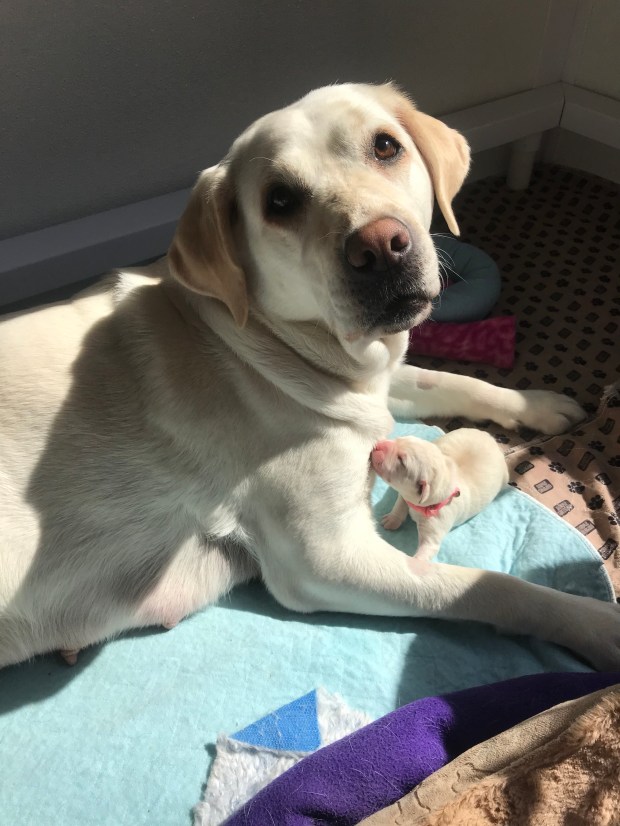
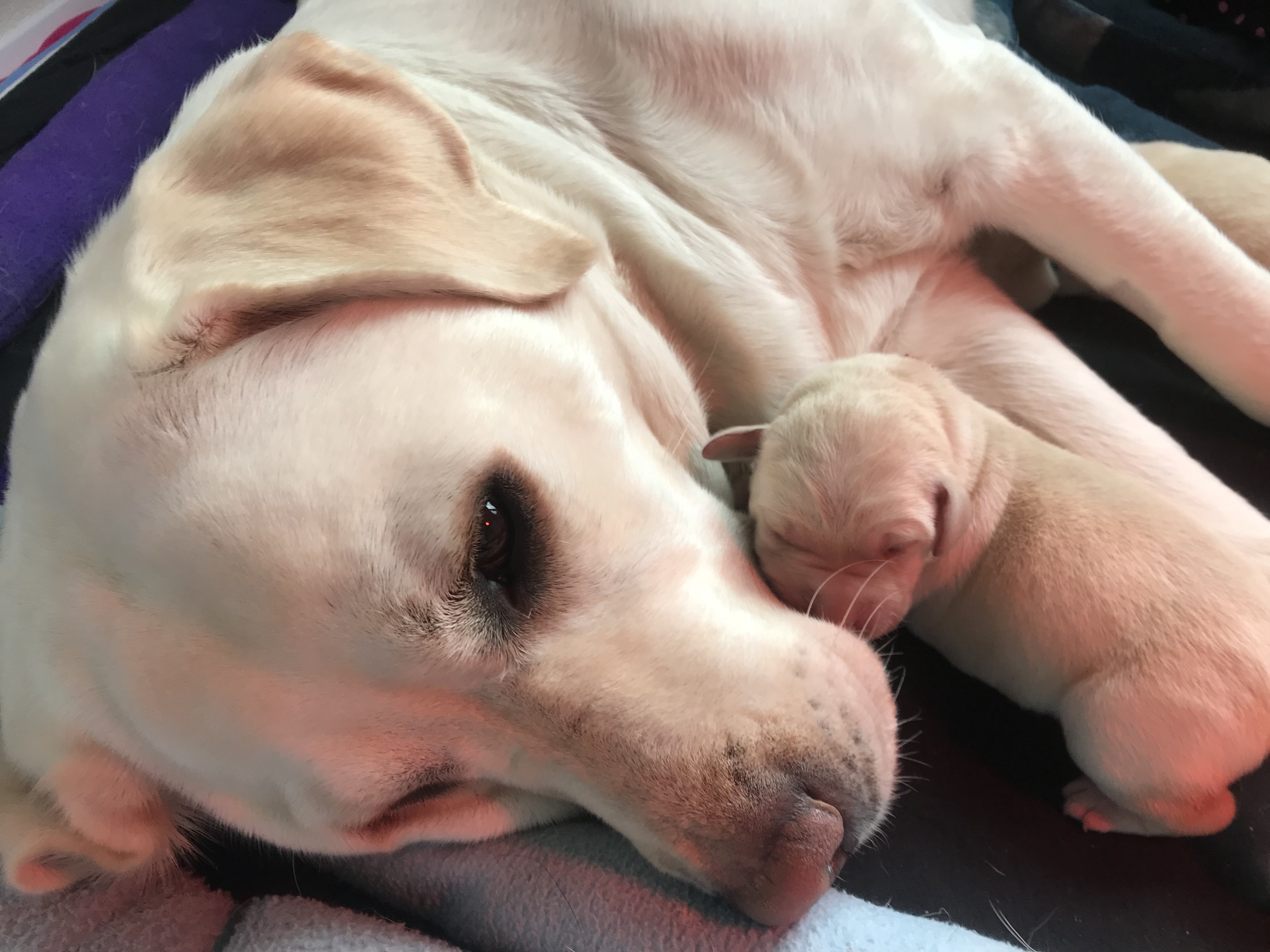
Sugar for sure is a natural at this motherhood thing, and the pictures below give you just a tiny glimpse of how evident that is when you watch her with her puppies, the “N” litter!

img_2566

Miss Pink having some one-on-one time with her Mama

Mr. Blue showing he knows what he wants and how to get it!


Sugar and her puppies are enjoying a sunny afternoon catching up on some much-needed sleep after 2 night shifts!


Visiting Stanley Prison: Over 6 Months Old and Growing-Far Away, Yet So Close To My Heart!

~Smiles turn into laughs and laughs turn into kisses-and before you know it, the days turn into weeks-and weeks into months.  And you find yourself forgetting who you were or what it was like before they were born~


the greeting at Stanley 1

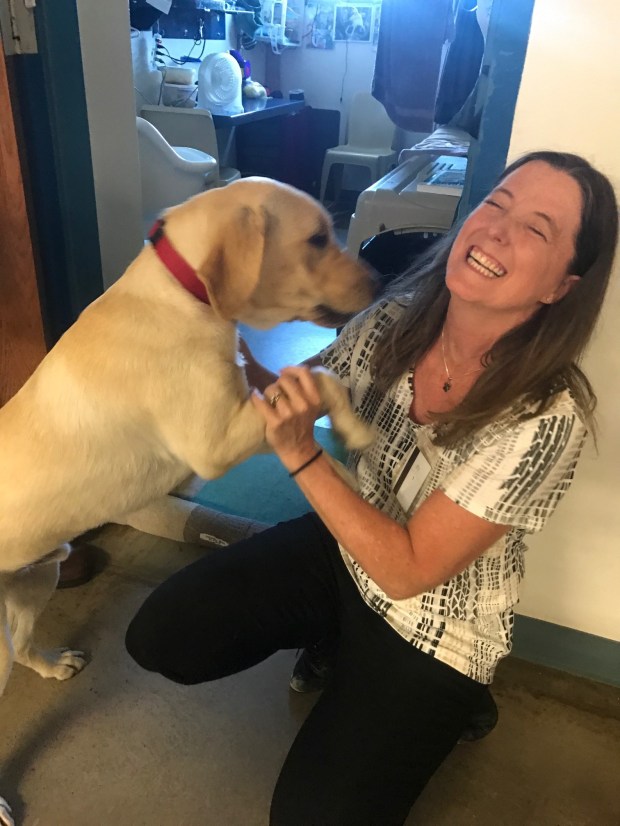
Their enthusiastic greeting reassured me that somehow they knew who we were! Liam’s tongue and tail were going like crazy, and I was loving every minute of it!


Holly and Lyric

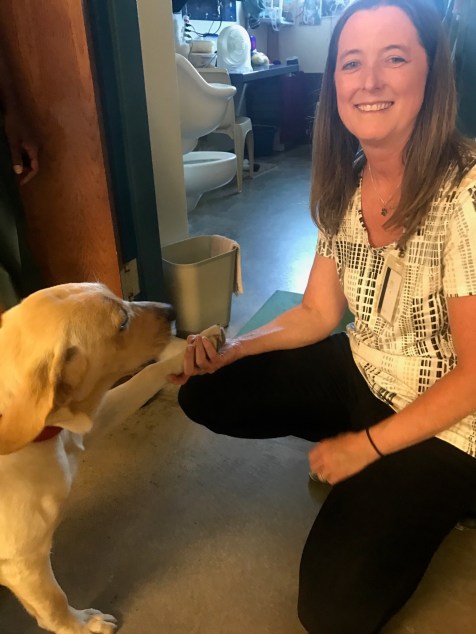
Lyric is still the bold, energetic pup that I remember!

The day that I have been thinking about for what seems like forever finally arrived!  Wednesday, June 7th was the day that I was able to go visit the 2 “L litter” pups Liam and Lyric at the Stanley Correctional Facility in Wisconsin and meet their handlers!!!! I was filled with every emotion possible: anticipation, nervousness, joy, and a touch of sadness that they are growing up so quickly. They are a little over 7 months old now, and I couldn’t wait to see them!

Ken and I talked about what we thought the visit would be like on our drive there-what we might see, whether the dogs would have any clue who I was, and what we would learn from the handlers and staff as we got to spend the day with them learning about the puppy program at Stanley and how they were doing working with Liam and Lyric.  I can honestly say if I took every expectation and thought that I was thinking in my mind about how I anticipated the day to progress, and if you asked me how it compares to the actual experience, it wasn’t anywhere close.


Stanley visit with Lyric and Liam

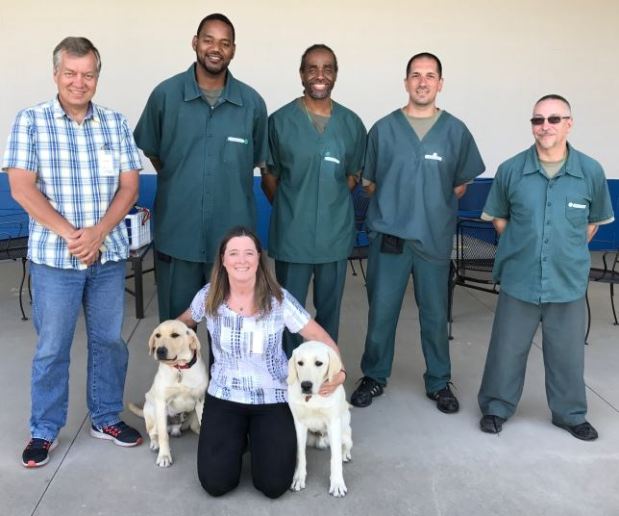
Lyric (left) and Liam (right) with the handlers (Vernon & Ronald are Lyric’s handlers-DeJay & Marc are Liam’s handlers), Ken and I


We made it through security (after a few tries on my part!) and walked through the first set of locked gates, and all of a sudden, off to my right,  I saw 2 beautiful yellow labs and 4 handlers working with them in the distance and I knew it was Liam and Lyric.  I’m not sure why, but all of a sudden the tears came!  Happiness to see them even at a distance, shock at how much they’ve grown,  that they were working diligently with their handlers and ignoring all of the sights and sounds around them…..probably all of the above! I couldn’t help myself and I enthusiastically waved through the fences to the handlers(and pups) in the distance!  There was a shift change, which meant that the security personnel for the evening was coming in, so we had to wait for a little in that area to allow for the change and the few minutes seemed like forever.  I intently watched the pups working on their tasks and anxiously waited to get to the other side so I could say hi to them!  Finally, it was almost time, and I had to catch myself from stepping in front of the staff to get to the outdoor area…

When I walked through the door, all I could see was those beautiful puppies in front of me as everything else surrounding me fell away.  For just a few moments it was me and them, and the joy for me was palpable. They greeted me, jumped on me and licked me and for that instant,  I knew in my heart that there was something, no matter how small, that they remembered about me!  Whether it was my voice, my “puppy, puppy, puppy” call, or the smell of their mom that undoubtedly was on my clothing-it didn’t matter!  The months since I last saw them disappeared as did the anxiety of the day and the worries of how they were doing!

Holly and Lyric 060717

After the unbelievable puppy reunion, I collected myself and apologized to the handlers for not saying hi to them yet!  They had patiently waited in the background and let Ken and I love all over those bundles of joy (which probably went against any rule of people petting assistance dogs, but I was reassured by the handlers and staff this was an expected situation and they didn’t have their capes on!).  We went through the introductions and questions were flooding my brain.  How do you like working with them?  What is the program at Stanley like? What is the difference between the two puppies? What have they learned so far? How has this changed you? What do your families think about you being in the program? I felt like I was throwing questions at them in rapid fire succession, and all of us had the added experience of being filmed by Mark the videographer while this was taking place. When Mark didn’t have the camera rolling or was trying to set up equipment, I tried my best not to ask any questions about the dogs or the program-but with little success.  Then in the background, I would hear Mark say “you can’t ask questions yet Holly….” and so I jokingly told the handlers they needed to keep me off-topic.

The conversations were honest, sincere, and thought provoking.  They got choked up when talking about what this program means to them and in turn it was all I could do to keep myself together. The handlers shared stories with me about their families, their journey with the dogs, how being in the program affects their daily life, and their heart.  They could have chosen to stay on the surface in their conversations with me, but they seemed to enjoy someone enthusiastically talking with them about something they love to do, a joy that we share together as volunteers, and I so appreciated their conversations!  I got a once-in-a-lifetime opportunity to see how powerful these assistance dogs in training can be for inmate handlers and the facility as a whole. Without a doubt, these dogs are changing many lives before they even make it to their final home with their forever human!  The prison program has always had a little bit of mystery surrounding it for me, not for lack of people trying to explain what it’s like, but because without seeing it sometimes it’s hard to believe and comprehend what others are saying.

So, what did I see?  I saw program staff that are absolutely all in when it comes to making sure this program is successful for everyone involved; I saw engaged handlers working with the dogs on tasks that will change someone’s life, I saw happy dogs, connected emotionally with their handlers, and I saw pride in the eyes of staff and handlers/sitters involved with the program.  Both the handlers AND dogs were eager to learn and eager to please.  I was able to visually see what my mind couldn’t understand before. Most importantly, I got to hear from the handlers themselves about the lessons they’ve learned from being part of this program; patience, tolerance, teamwork, understanding that the most important goal is the success of the dog(and that it sometimes takes a little while to come to this realization!), confidence, giving back in an extremely tangible way, and how change is possible if given the right tools.

And what about the dogs?  What have they learned?  They’ve learned tasks at their young age that I haven’t even been able to train for with the dogs we puppy raised in our own home through adulthood!  They can go to their handlers based upon a specific “call” that is different from others and they know which one belongs to the call, the heel, side, sit, down, tug, under, park, clean up, spin, front, back, away, and Liam can wait without eating food out of his bowl while his handler goes to another floor and gets coffee-releasing him when he returns. They know that when their collar comes off, they go to their kennel even when they are outside of the room. I could continue with many more skills they know, but suffice it to say that training is happening and is very successful! Lives are changed because people are taking the time to invest their heart and energy for a cause bigger than themselves.


Liam and his handler 060717

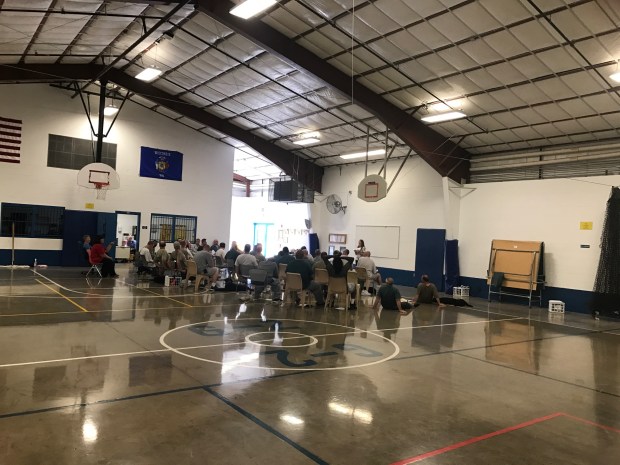
Talking with the handlers/sitters about the whelping program


And if that wasn’t amazing enough in every way, I then got to have a “learning session” with the entire training group and share my story of being a whelping home, explaining how that part of the organization works to bring puppies to the program for training. I told myself if I saw boredom or 3 handlers start to doze out of boredom, I would stop talking have them use the training time for the dogs instead-but to my surprise they sat listening and asking wonderful questions about all aspects of the program.  And afterward, many came up to Ken and me, shaking our hands and thanking us for what we do-and all we could do was thank them right back for volunteering too! After all, we are all volunteers for the same mission and vision!

And when I asked the handlers how they’ve learned all the skills they have acquired, with a broad smile they replied that “Miss Dyan” (Can Do Canines Trainer that handles Wisconsin) has taught them everything they know!

Out of all the lessons that I took away from my experience, (which were many!) the most basic takeaway for me was this: Mistakes have been made in their past, that’s true-but it doesn’t (and shouldn’t) define their future OR their ability to make a positive difference in the lives of others . Isn’t that what we ALL hope for in our own lives as well at the end of the day?

Day 70: The Journey-A Day Full of Firsts!

It is 2:54 am, and tonight sleep is evasive; the puppies are tucked safely away in their new homes and all is returning back to normal(except for the not sleeping part!). But unless you have had a litter of puppies in your home, the one thing that no one prepares you for is that although these are “just puppies” and they were only in my home for a short 7 weeks of their lives, they get a piece of my heart for a lifetime. I don’t stop worrying about them or thinking about them because they aren’t present in my home-it reminds me instead of when my own children went off to college. I frequently think of Sugar’s first litter that are almost 1 1/2 years old, counting down to the time when they will meet their person. Tonight I woke up after dreaming about the puppies and couldn’t fall back to sleep, so decided to write for awhile.  But as I write this, I once again realize and appreciate the fact that although they aren’t with me, whelping homes are SO lucky because we get to experience their journey vicariously through the joy of others!

When the updates on the puppies started arriving as early as the same evening of the transition I was thrilled!  I anxiously waited until the next morning to check Facebook (okay, SCOUR Facebook!) and see how their first night had gone in their new homes, what puppy antics they had put their new puppy raisers and great start homes through, and how they were adapting to yet another change in their lives. It’s an emotional roller coaster that no one can adequately prepare you for, and as with anything else I’m sure everyone feels varying degrees of attachment to pups that they raise in their home. I am one of those that feels large amounts of emotion so it seems fitting that my connection to these pups would continue, just as it did with Sugar’s first litter.  I somehow feel an “ownership” in how their journey plays out just as I’ve done in the past when I have been a puppy raiser.  I also think that doing this blog and facebook page to document the journey and share it with others has increased my connection to these puppies since I have spent a lot of time thinking and writing about them! I think that the varied connections to these dogs are what make the volunteer journey so special.

leonard

Leonard with his new family friend!

lizzie-with-osmo-the-first-night

Lizzie with her new pal!

linus-at-work-the-first-day

Linus learning the ropes at Can Do Canines where he will get to visit frequently with his puppy raiser!

lola-on-her-first-night

Lola learning where the best napping spots are in her new home!

lyric-first-day-with-ace

Lyric with his new buddy!


liam

Liam with his new confidante!

When I think of the number of people that touch the lives of these dogs to get them to their final placement, it’s almost overwhelming. If the program gets in 70 puppies throughout the year, 70 or more new volunteers are needed. Breeding Fosters, Whelping Homes, Great Start Homes, Puppy Raisers, Inmate Puppy Raisers, Fosters, volunteers that exercise the dogs at the facility and take them on outings to make sure they are ready for their duties, Trainers, Staff that connect the dots for each of the dogs coming into or leaving the program and the list continues.  Each of us gets to put a piece of the puzzle together to create the building blocks of the assistance dog in training on the “yellow brick road” to their client.


When that dog doesn’t make it to what we have already built in our mind as their destiny, disappointment follows-at least I know it does for me. It doesn’t matter the reason for the detour; many of us think if there is something we could have done differently-if we could have worked harder, if we could have trained better.  In our minds, we know that many things determine whether a dog graduates from the program-but our heart takes the lead and it’s hard not to make it personal because we’ve put a lot of time and energy into “our dream” to make them great. I don’t pat myself on the back and tell myself “Well Holly, you did a great job anyways”-but rather “what did I miss and how could I have done it differently?” I don’t beat myself up over it as I know there are MANY reasons a dog may not make it through the entire program and many of those reasons are completely out of my control, but I would be lying if I said that once a dog has spent time with me in my home that I don’t take a vested interest in their success 🙂

But, on the other hand, when a dog whose life we have touched makes it to that pinnacle moment and our dream for them is realized I can only imagine what that will feel like.  I say that because although I have been a volunteer for more than 5 years I have yet to be “in that moment”.  I’ve lost count of the number of dogs through our home.  We have tried to volunteer in as many opportunities as possible including great start, puppy raising, fostering, breeding/whelping etc. We have puppy raised three incredible dogs, all three were a different breed of dog-all with VERY different journeys.  One was career changed(now a very happy and loved family pet for someone), one was moved into a different career path, and one is in final training to become possibly a mobility assist dog. But then there are the puppies that have been through our home and just as anxiously I wait for them to move through the program because I am equally thrilled to follow their journey!  I feel a similar connection to them although I wasn’t a part of their formal training and growing up years-but I WAS part of their beginning days! I personally believe that everyone who has a hand in touching the lives of these pups rightly deserves the opportunity to celebrate in some form or another when they find their forever person!

So, the next time you see someone with a service dog in training and you want to ask them the #1 question we get asked of “How can you give them up after you have them for so long?”(Just for the record, the answer is “It’s hard! And, yes, we are sad to say goodbye. But we try to keep our mind on the final goal and remember that this dog will change someone’s life and that is incredibly AWESOME!”), try asking a different question instead to get a better picture, like”How do you feel when you see them change a life?”, “Why do you choose to do this kind of volunteer work?”, or the best question, “How can I help?”  I think you will be inspired by the answers you hear!!!!